

Handling liquid fertilisers and preservatives on the farm: safety, ergonomics and practical procedures
Handling liquid fertilisers and preservatives on the farm is part of the day-to-day workflow, where small routines make all the difference: a stable work surface, a clear sequence of tasks and splash control reduce accidents without the need for unnecessary fiddling about. When handling is carried out as planned, the work is safer, more ergonomic and often quicker too. This article discusses…

Voit jättää meille soittopyynnön
Jätä nimesi ja numerosi, niin soitamme takaisin saman päivän aikana.
Handling liquid fertilisers and preservatives on the farm It is a routine part of everyday work where small routines make all the difference: a stable work surface, a clear sequence of tasks and splash control reduce accidents without the need for unnecessary fiddling. When handling is carried out as planned, the work is safer, more ergonomic and often faster too.
This article provides a practical overview of the handling of chemicals and liquids on farms and in contracting work: what should be standardised, where risks typically lie, and what sort of maintenance and inspection routines keep both equipment and people safe. It also includes a focus on IBC containers and racks, as transport and handling often take place using a tractor or wheel loader – precisely where vibration, centre of gravity and splashes become a real issue.
Handling liquid fertilisers and preservatives on the farm: risks and basic principles
The risks associated with liquids and chemicals are usually a combination of factors: slipping, splashes on the skin and in the eyes, respiratory tract irritation, the mixing of incompatible substances, and failure to secure loads during transport. Many hazardous situations arise in a rush, precisely when people think “this will be done in a jiffy” – and safety goggles or gloves are not worn, a hose is connected carelessly, or a container is lifted unsteadily.
A good starting point is to create a standardised procedure for each stage of the work: where the tank is located, in which direction the valve opens, where the hose is routed, where any leak is channelled, and where the emergency shut-off/flushing point is. When the same process is repeated, the potential for errors is reduced and even new employees learn more quickly. General guidelines and hazard labels relating to the safe handling of chemicals can be found, for example, in the ‘Basics of Chemical Safety’ From the Wikipedia article, but in day-to-day farm life, the most important thing is to adapt the guidelines to your own workstations and equipment.
Three practical principles that will take you a long way Once these are in order, most of the everyday risks are significantly reduced.
Keep your workstation the same Always keep the container, hoses and protective equipment in the same place – this routine helps prevent “accidental” splashes.
Control your movement and centre of gravity The load moves with the vehicle; check the securing, bracing and lifting method before setting off.
Give the leaks a “direction” Think in advance about where a small drip or splash might end up – and how to mop it up without spreading it.
If an IBC container is being moved by a tractor or a loader, transport-related risks often become the primary concern. A good further read is the article by Lootu Oy Transporting an IBC container safely by tractor: the 7 most common mistakes and how to avoid them, which examines typical pitfalls using practical examples.
A stable platform and splash control in practice
A stable surface is essential for handling chemicals: it must be level, load-bearing and, ideally, easy to clean. If the surface is soft, sloping or uneven, it becomes more difficult to control the container and hoses, and splashes are more likely to occur. If handling takes place in a yard, even a slight slope can cause spills to flow in the wrong direction – and, in the worst case, the liquid may start “running” towards a drain, a doorway or a walkway.
A clear distinction between the “dry zone” and the “wet zone” helps with splash control: the dry zone is where you keep your safety goggles, gloves, absorbent materials and tools. The wet zone is the area around the tank, valve and hose connections, where small splashes are to be expected. This division helps ensure that you do not spread the chemical around the room on your shoes or hands.
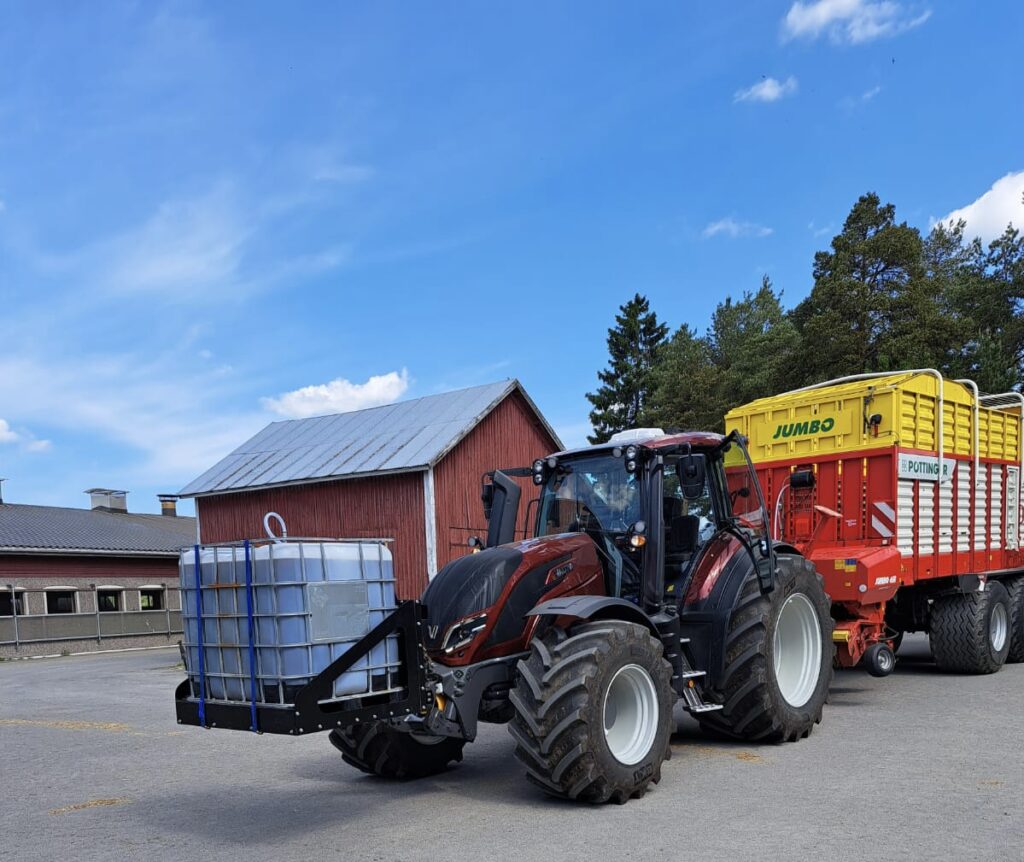
When the tank is used on a tractor or loader, leak prevention begins right from the transport position: the valve orientation, hose routing and attachment points should be chosen so that the hose cannot rub against anything or become pinched. If you are using a mounting bracket, choose a model that keeps the tank in place despite vibrations and allows for a comfortable working position. Compiled by Lootu Oy How to choose the right IBC container rack helps you visualise the load, the attachment points and the intended use all at once.
Once the processing point is stable and repeatable, the risks do not “disappear” – but they become manageable and predictable.
Ergonomics: lifting, hoses and work procedures without unnecessary strain
When working with chemicals, ergonomics is about more than just your back: it also involves your hands, wrists, shoulders and balance. A common problem is twisting whilst handling a hose in the wrong position or lifting it whilst standing on a slippery surface. The aim is to ensure that hoses can be connected “from the front and up close” without having to reach out – and that operating the valve does not require a sudden jerk.
A good procedure is simple: check, connect, verify, open, monitor, close, disconnect, clean. When this sequence is followed in the same way every time, any anomalies are also spotted more quickly (e.g. pressure behaviour, a leaking connector, pulsation in a hose). An ergonomically sound solution is to position protective equipment and absorbent material so that you can reach them in a single step – rather than having to leave your workstation mid-dispensing.
Ergonomic quick fixes for everyday life Small changes reduce the strain throughout the season.
Hose at the correct height Position the container and the stand so that the connectors are at hand level – not at knee or head height.
Avoid twisting Use connectors and tools that minimise wrist rotation; tighten in a controlled manner – do not “over-tighten just to be on the safe side”.
Keep the walkway clear A single slip on a spill can lead to serious exposure – clean up even the smallest spill straight away.
Mark the “operating position” Establish a clear procedure for determining whether the valve is closed or open and who is responsible for monitoring the flow.
If you’re unsure about how to install or secure the rack, referring back to the instructions often saves more time than guessing. Lootu Oy’s website Installation instructions It serves as a useful checklist when you want to make sure that the attachment points, locks and operating position are correct before the busy season begins.
A brief note
When an IBC container is used for several different liquids (e.g. irrigation water, washing water, preservative), clear labelling and a dedicated “basic set” of hoses reduce the risk of mixing and unpleasant odours.
Maintenance routines: leak testing, cleaning and the condition of the rolling stock
Maintenance is often the first thing to be neglected – and that is precisely why it’s worth making it easy. The aim is to identify a few “essential” checks that are carried out every time before and after use. Hoses, couplings and valves are the most common sources of leaks: a small drip can easily go unnoticed, but over time it collects dirt, weakens the seals and makes the work area slippery.
The basic principle of cleaning is: release the pressure, close the valve, allow the contents to drain off in a controlled manner, rinse as appropriate, and dry and tidy the workstation. If you are handling preservatives, odours and residues may adhere to equipment; in such cases, a clear procedure (a dedicated rinsing area, separate storage and, where necessary, separate hoses) reduces cross-contamination. With liquid fertilisers, on the other hand, corrosion and crystallisation can cause unexpected blockages or connectors to “seize up”, in which case applying excessive force increases the risk of breakage.
| In a moment | When | Why is it important? |
|---|---|---|
| Hoses and fittings | Before each use | Cracks and loose joints are the most common source of splashes. |
| Valve operation | Weekly during the busy season | Jamming increases the likelihood of sudden force being applied and the risk of breakage. |
| Rack fixings and locking mechanisms | After every transfer | Vibration and movement of the load can loosen fastenings and shift the centre of gravity. |
| Workstation cleanliness + absorbent material | After each treatment | The risk of slipping and exposure is reduced when splashes are dealt with immediately. |
When equipment is used all year round (e.g. for cleaning and watering in property maintenance), you should also check for the effects of frost: freezing can damage valves and connectors or affect the flexibility of hoses. Preventative replacements (seals, short lengths of hose, quick-connect fittings) are often cheaper than a single major clean-up and repair job.
Minimising risks without adding complexity: clear procedures and responsibilities
The best safety procedure is one that is actually followed. That is why the process should be short, visible and straightforward: a single laminated checklist near the workstation, a clearly designated storage area for equipment, and agreed responsibilities. Once it has been agreed “who checks and when”, things are not left to chance.
A surprisingly effective approach is to divide the work into three roles – even if the same person carries them out one after the other: (1) the preparer (protective gear and equipment), (2) the operator (switches on and dispenses), (3) the finisher (rinsing, cleaning, record-keeping). This ensures that every stage is completed. Furthermore, it is worth noting any deviations in a single sentence (e.g. “the connector was leaking, seal replaced”), so that lessons learnt accumulate from one season to the next.

When using IBC containers, safe handling is made considerably easier if a sturdy transport and operating platform has been designed for the container. Lootu Oy (Pekurinpolku 3, 90450 Kempele) manufactures sturdy and easy-to-install racks in Finland for tractors and wheel loaders – designed for practical work needs. If you’d like to compare the options quickly, take a look at products and choose the appropriate product range for your application (irrigation water, washing water, preservatives or liquid fertilisers).
When the tank is being moved: transport, securing and safe, smooth operation
A moving tank changes everything: the centre of gravity shifts, the liquid sloshes about and the vibrations put a strain on the fixings. That is why Handling of liquid fertilisers and preservatives on the farm It is advisable to plan so that transport and use form a single integrated process – rather than separate “temporary” solutions. When the rack and mounting system are designed for the intended use, transport is not merely a necessary evil but a controlled part of the process.
It is good practice to define a clear “transport position” and “operating position”. In the transport position, the valves are protected, the hoses are connected and locked in place, and nothing is left to swing about or rub against anything. In the operating position, on the other hand, you can access the couplings safely without having to lean on the tyre, step onto a slippery surface or reach over the lifting equipment. This improves ergonomics and also reduces the risk of a connector becoming only partially engaged.
Checklist for relocations and the construction site These tips will help you avoid the most common accidents when the tank is being moved around the yard or on the road.
Check the fastening by eye and by hand Just saying “it looks good” isn’t enough – check that there is no play in the rack.
Keep hoses short and protected A short, correctly routed hose reduces chafing and tearing.
Make sure to pack a “first-aid kit for bleeding” Having absorbent material and a spare pair of gloves in the tractor saves time if anything happens.
The same logic applies to property maintenance: when water is transported for sweeping or washing, safe handling of the container reduces mess in the yard and speeds up the pace of work. If this is a topical issue, do have a look at Water for brushing, with a focus on practical water logistics at construction sites.
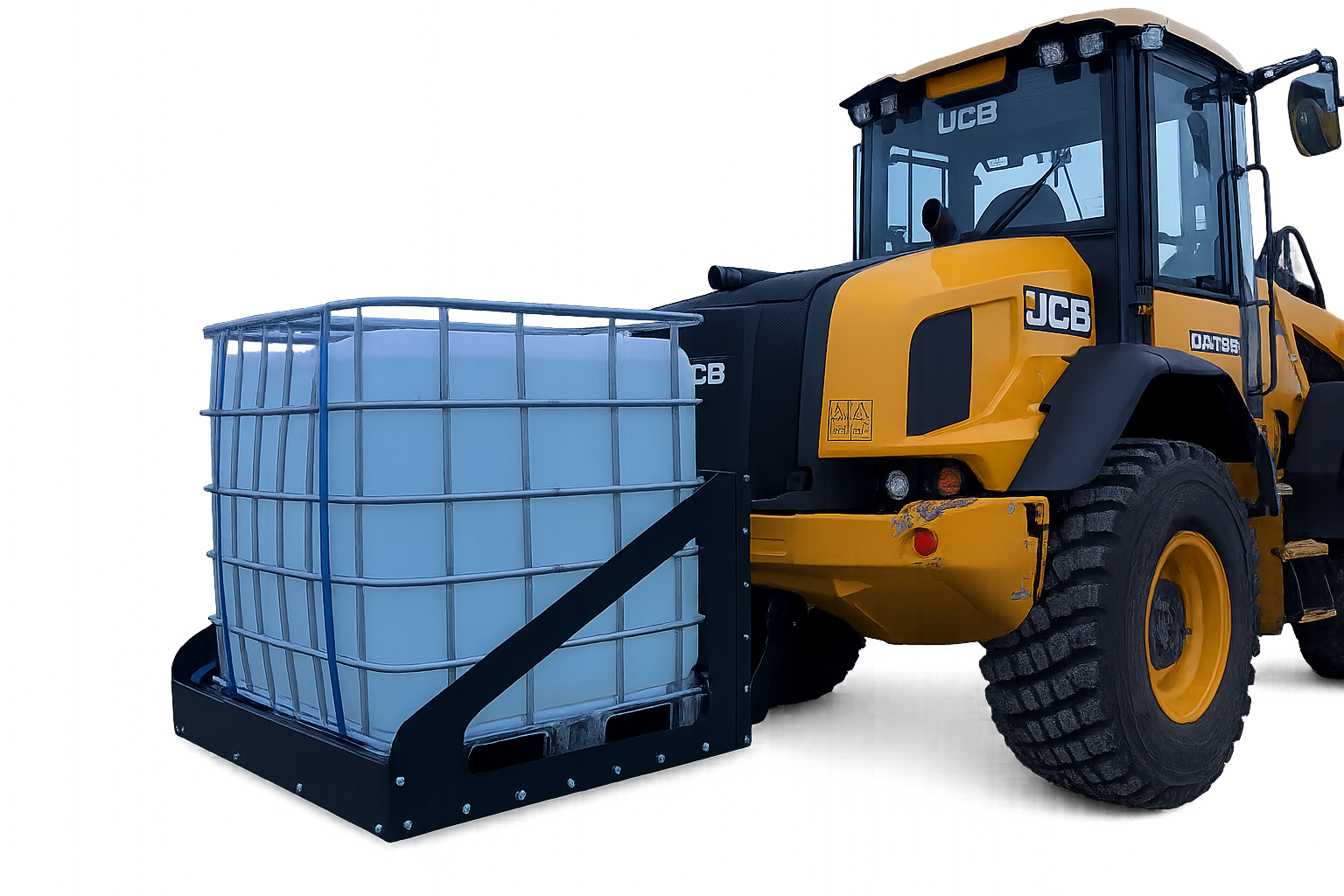
In conclusion: if your aim is to minimise risks without making your daily life more complicated, choose 2–3 routines and stick to them. Once your workstation is set up, your equipment is always to hand and your rack or mounting is in good condition, Handling of liquid fertilisers and preservatives on the farm It goes from being a “chore” to a smooth part of the working day – and at the same time, the likelihood of accidents drops significantly.
Would you like a safer and tidier everyday life with your tank?
Lootu Oy can help you choose a sturdy rack for your IBC container, designed for practical use on a tractor or wheel loader.
Frequently Asked Questions
What are the most common risks involved in handling liquid fertilisers and preservatives?
How can splash control be improved without major investment?
Why do the rack and the mounting affect ergonomics?
What maintenance routines should you carry out during the busy season?
Can the same IBC container be used for several different liquids?
Interested? Get in touch with us!
Please get in touch with us using the form below