

Transporting an IBC container safely by tractor: the 7 most common mistakes and how to avoid them
Transporting an IBC container safely on a tractor is possible provided that your driving technique, load securing and attachment points are all in order before you start moving the container. On farms and in property maintenance, IBCs are often used to transport irrigation water, washing water, preservatives or liquid fertilisers – and even the slightest mistake can cause the container to tip over or leak…

Voit jättää meille soittopyynnön
Jätä nimesi ja numerosi, niin soitamme takaisin saman päivän aikana.
Transporting an IBC container safely on a tractor This can be achieved if your driving technique, load securing and lashing points are all in order before you start moving the container. On farms and in property maintenance, IBCs are often used to transport irrigation water, washing water, preservatives or liquid fertilisers – and even the smallest mistake can cause the container to tip over, leak or create a hazardous situation on the premises.
This practical guide outlines the seven most common mistakes that are made when moving an IBC container using a tractor (or a tractor’s front loader). At the same time, you’ll learn clear ways to avoid risks: centre of gravity, support frame, load securing, route selection and working methods – as well as tips on when a sturdy support frame is the most sensible and safest solution.
1) The initial situation is misjudged: mass, fluid motion and centre of gravity
The first and most common mistake is to underestimate the behaviour of the combination. An IBC container may appear “compact”, but when it contains hundreds of litres of liquid, the total mass increases rapidly and the centre of gravity rises. Furthermore, liquid does not behave like a solid load: it moves, sloshes about and shifts the centre of gravity, particularly during acceleration, braking and cornering. In practice, this means that the tractor feels as though it is “rocking” or the load starts to take on a life of its own.
Avoid this by carrying out a quick initial assessment each time: what you are carrying (water, preservative, fertiliser), how full the container is and where it is positioned (at the back/front, top/bottom). If an IBC has been lifted high onto a front loader, even a slight tilt or a bump can increase the risk of it tipping over. If, on the other hand, the container is at the rear and extends beyond the rear of the wheelbase, manoeuvrability and front-axle grip are reduced.
A quick “before setting off” check Make this a routine, particularly in outdoor areas and on construction sites.
Filling rate A half-full container can be misleading, as the liquid is free to move about more.
Lifting height Keep the load as low as possible and close to the tractor throughout the entire journey.
Route Choose the flattest route; avoid cross-slopes and kerbs.
Tyres and grip Check your tyre pressures and bear in mind the effects of gravel, ice or wet grass.
2) Transporting an IBC container safely on a tractor requires the correct rack – not a “make-do solution”
Another common mistake is to rely on temporary solutions: a container on a platform without proper support, on a pallet without lateral guidance, or secured “somehow”. The metal cage and plastic container of an IBC are designed to withstand use, but they do not in themselves constitute a transport frame. If the load starts to shift, there is a risk of both the container tipping over and being damaged (for example, if the tap or base is struck).
The basic safety principle is simple: the rack must prevent movement forwards, backwards and sideways, provide clear attachment points and fit the machine in such a way that installation does not require any “fiddling about”. Lootu Oy (Pekurinpolku 3, 90450 Kempele) develops and manufactures IBC racks designed for practical use on tractors and wheel loaders, making the load easier to manage both in day-to-day farm work and in property maintenance contracting. When the rack is correctly sized, securing the load becomes a repeatable routine – not a project that has to be reinvented every time.

If you’re choosing a rack or comparing options, start by considering the load, the mounting points and the intended use. A good next step is to take a look at the guide How to choose the right IBC container rack, which emphasises the same basic safety principles: a stable base, secure fastening and suitability for everyday use.
Safety does not come from a single strap – it comes from ensuring that the IBC cannot move in any direction, even in an emergency.
3) The fastening is done incorrectly: the straps, corners and attachment points fail in practice
The third mistake is technical but common: the load is secured in a way that appears to hold it in place but cannot withstand dynamic stress. If the straps are simply pulled “over the container”, they may press against the plastic, slip off the top of the cage or come loose due to vibration. It is even more dangerous to secure a strap to a weak point (such as plastic parts) or to use worn-out equipment without checking its condition.
Avoid this by ensuring three things: (1) you use securing equipment that is in good condition and suitable for its intended purpose, (2) you attach the straps only to load-bearing structures, and (3) secure the slings in such a way that they prevent movement in the lateral direction as well. Also check that the corners of the slings do not rub against sharp edges without protection, and that the fasteners are secured so that they cannot come undone due to vibration or impact.
A practical “how-to” guide to binding” These tips will help you avoid the most common registration errors when transferring ownership of farms and property maintenance contracts.
Make use of the rack’s mounting points When the markings are clear, the cloth doesn’t have to find its own position and doesn’t slip.
Prevent sideways movement Simply “over-steering” isn’t always enough if the road is uneven or you have to take a tight bend.
Check the tension again Drive a short distance, stop and check the tension of the belts before setting off on a longer journey.
Protect areas prone to scuffing Corner protectors and correct routing extend the life of the cloths and improve safety.
It is also worth familiarising yourself with the basic principles of load securing and the aim of lashing (to prevent movement in different directions). You can find a general overview, for example, of the basic concepts of load securing and the legislative background Cargo securing - from the summary.
4) Driving style not suited to the load: speed, bends and sloping surfaces
The fourth mistake is “driving as you always have done”. With an IBC container, even minor choices in driving style become more pronounced, as the liquid load introduces a delay in movement: when turning, the liquid continues “straight ahead” for a moment; when braking, it surges forwards; and on uneven surfaces, it sloshes about. This is particularly noticeable in yards with kerbs, manhole covers, slopes or soft edges.
Avoid the risk of overturning and spilling by driving carefully: slow down before a bend (not whilst turning), avoid sudden steering movements and keep the load low. If the route forces you to drive across a sloping surface, consider an alternative: where possible and safe at the site, drive “up and down” the slope rather than across it. In property maintenance, pedestrians, yard traffic and narrow gateways also increase the need to drive at a steady, controlled pace.
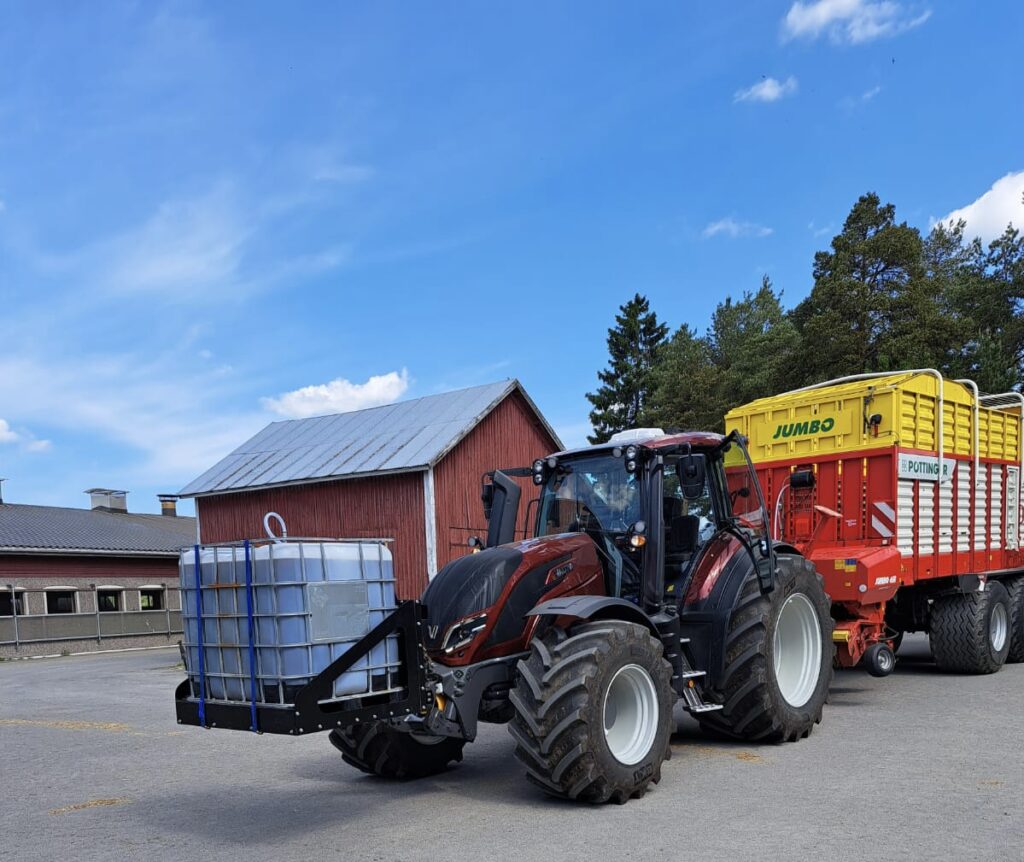
It is good practice to work in pairs: the driver concentrates on steering, whilst another person checks the field of vision, gates and narrow sections where necessary. If you are working alone, it is better to stop twice to check than to try to “get it done quickly”. When transporting preservatives or liquid fertilisers, the consequences of any spill are also more serious: in such cases, foresight is not only a matter of occupational safety but also of managing environmental risks.
A brief note
Once the scaffold has been correctly erected and the attachment points are clearly marked, working safely becomes quicker – because every movement is repeated in exactly the same way.
5) Leak and chemical risks are overlooked: valves, safeguards and emergency procedures
The fifth mistake is to focus solely on tip-overs and overlook the management of the risk of leakage. The weak point of an IBC during transport is often the tap/valve and its surroundings: an impact, vibration or a poorly directed hose can cause seepage or, at worst, break the tap. If the load contains preservatives, cleaning chemicals or liquid fertiliser, a leak is not just a mess – it can lead to slipping, damage to property and environmental harm.
Avoid this by securing the tap and ensuring that it does not catch on anything when lifting or moving it. Also check that the lid is tight and that the hose connections are secure before moving it. In addition, draw up a “what if” plan: where you will stop if you notice a leak, what absorption or collection equipment is available, and who to alert if necessary. Even a little preparation reduces stress should anything go wrong.
| A common mistake | Why is it a risk? | How do you avoid that? |
|---|---|---|
| The tank is half-full and is being lifted high | The liquid moves and the centre of gravity rises | Lower lifting height, a smooth driving style, avoid side-to-side tilting |
| Attachment only “over the cage” without lateral support | The load may shift during cornering | Use the mounting points on the rack and prevent movement in all directions |
| The valve remains unprotected | A blow could break the tap and cause a leak | Cover the tap, route the hoses, and check for leaks before driving |
| People are driving too fast in the car park | A pothole or kerb increases the risk of falling | Slow down in good time, choose the smoothest route, and stop to check |
If you regularly transport preservatives, consider a solution designed specifically for this purpose. Lootu Oy’s preservative rack has been specifically designed to withstand vibrations and changes in weather conditions, and to provide a stable base so that a chemical spill does not catch you off guard in the middle of the working day.
6) Lack of maintenance and routine checks: a checklist and training can help prevent damage
The sixth mistake is to rely on the fact that “it’s worked before”. The safe transport of an IBC container by tractor is based on routines: the same checks every time, the same sequence for securing the load and the same driving style. When there are several factors involved in the work (the farm, relief workers, the peak season, contract work), it is precisely these routines that prevent someone from setting off with inadequate lashing or forgetting the tap position.
Introduce a short checklist that suits your day-to-day operations: the condition of the scaffolding, attachment points, slings and tensioners, valve protection, the route and visibility. At the same time, it is worth agreeing on some common rules: where the load is to be lifted, where the tightness of the lashing is to be checked, and when work should be suspended (for example, if the route is icy or there is too much traffic in the yard).
Safety procedures that pay for themselves By following a few simple tips, you can minimise damage and save time.
One responsibility, one decision Let’s agree on who will decide whether to go ahead with the move or call it off due to the circumstances.
“A ”Stop and Look’ moment Before a gate, junction or narrow stretch of road, stop and check the route.
User guide for new contributors A brief introduction to the type of harness and how to fasten it reduces seasonal errors.
Regular replacement of equipment Worn-out locks and damaged locks are a minor risk that can be eliminated in advance.
When the aim is to ensure smooth water logistics – for example, in sweeping and cleaning operations – the whole process becomes considerably easier if the rack is designed specifically for that purpose. See also water for brushing - Principles of the solution: as the container is stable and easy to handle, work progresses smoothly from one location to the next – from Kempele to Oulu, Liminka or Raahe.
7) The final error: the compatibility between the rack and the item to be stored is not verified
The seventh mistake is to choose a trolley or method of transport without ensuring that it is actually suitable for the intended use. On farms, journeys may be short but uneven (field edges, potholes), whereas in property maintenance, vehicles are often driven in courtyards, on ramps and through narrow passages. The same tank and the same tractor will behave completely differently depending on the route and the intended use of the load. Furthermore, the rack must be compatible with the machine’s mounting points and any additional attachments, so that the installation is not left “half-finished”.
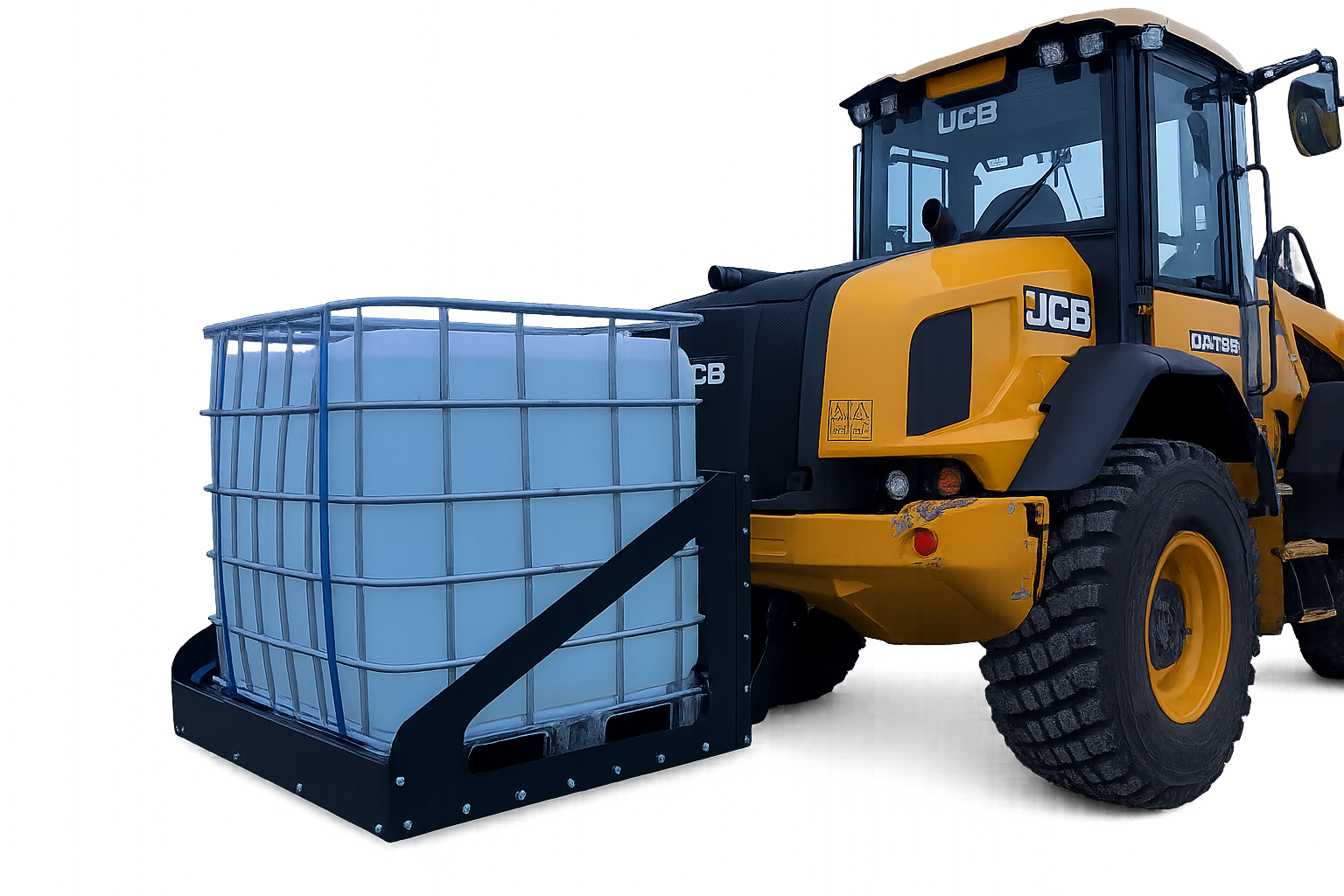
You can avoid this by carefully assessing compatibility: which machine the rack will be fitted to, what the typical transport distance is, what fluid is used, and what kind of stops are involved in the work. Once these factors have been defined, choosing the right solution becomes easier. Lootu Oy’s expertise in metal products is particularly evident in the fact that the racks are designed for heavy-duty use, are easy to install and are fitted with sensible attachment points – so that the IBC is not “merely in tow”, but a genuinely controlled part of the work machine.
If you want to find out which rack is best suited to your needs (water, washing water, preservative or liquid fertiliser), start by browsing our range: Products. If necessary, you can contact Kempele directly: Lootu Oy, Pekurinpolku 3, 90450 Kempele, tel. 050 374 7690, email [email protected].
Are you looking for a safer way to transport IBC containers?
Lootu Oy helps you choose the right attachment for your tractor or wheel loader for everyday use, ensuring that your load remains stable and your work proceeds safely.
Frequently Asked Questions
Why can a half-full IBC container be more dangerous than a full one?
How can I prevent an IBC container from sliding sideways whilst being transported by tractor?
Can an IBC container be transported on a front-loader?
Which parts of the IBC should be protected in particular to prevent leaks?
How do I know which IBC rack is best suited for a farm or property maintenance?
Interested? Get in touch with us!
Please get in touch with us using the form below