

CE marking for IBC container racks, machinery and occupational safety: what should property maintenance and farm operators check before use?
The CE marking on an IBC container rack is not just a sticker on the frame, but a practical tool: it indicates that the manufacturer has assessed the rack’s compliance with requirements and provided documentation to help you use the entire system safely in everyday use. In property maintenance and on farms, IBC containers are often moved in a hurry, under varying conditions and…

Voit jättää meille soittopyynnön
Jätä nimesi ja numerosi, niin soitamme takaisin saman päivän aikana.
CE marking for an IBC container rack It is not just a sticker on the frame, but a practical tool: it indicates that the manufacturer has assessed the rack’s compliance with requirements and included documentation that enables you to use the whole unit safely in everyday life. In property maintenance and on farms, IBC containers are often moved in a hurry, under varying conditions and using different machines – which is why, before use, you should ensure the safety of both the rack and the method of use (load management, secure fastenings, visibility and working practices).
This article sets out a practical checklist: what you should check on the rack, what documents you need, how to secure the load correctly, and at what point responsibility passes from the manufacturer to the user. The examples are suitable for both tractor use and wheel loaders, and the approach is the same as that of Lootu Oy in Kempele – the rack must function effectively in real-world working conditions, in Finnish weather and within routines where safety is made easy.
CE marking for IBC container racks: what should this mean in practice?
CE marking for an IBC container rack typically relates to machinery and equipment safety when the scaffold is classified as a machine or part of a machine (or it may fall within the scope of requirements relating to lifting equipment/load handling, depending on the product’s intended use). From the user’s perspective, the most important point is that the CE marking is based on an assessment of conformity and that the delivery includes essential information: the intended use of the scaffolding, the loads it is designed to bear, the method of attachment and any restrictions.
If the rack is delivered to a farm or property management company as a “ready-to-use package” and is used as part of a piece of machinery (e.g. a tractor front loader, three-point hitch, wheel loader attachment), safety depends on the system as a whole. This means that even if the frame is sturdy, risks can still arise from its use: excessive load, incorrect centre of gravity, inadequate locking or reduced visibility. The CE marking does not eliminate the need for your own inspections – it simply makes them more systematic, as the instructions and limits should be clearly defined.
A good rule of thumb: if you cannot find load ratings, operating instructions or information on compatible fixings, do not make any assumptions. Request the relevant documentation before putting the rack into production use. You can also find general guidelines on CE marking in official summaries, for example From the EU-OSHA website, which deal with workplace safety and risk management.
A quick CE check for users When the hoist arrives in the yard or the depot, check these over before the first lift.
Markings and signs Are the manufacturer, model, serial number and load ratings clearly indicated?
User Guide Does the manual cover installation, use, maintenance, restrictions and warnings – not just “general instructions”?
Compatibility Has it been specified for which types of attachments, loaders or three-point hitches the frame is designed?
Documents saved Keep the instructions and any declaration of conformity in a place where employees can actually find them.
Machinery and occupational safety in practice: risks arise from the bigger picture
In property maintenance, IBC containers are typically used for the logistics of cleaning and watering water, and on farms they are also used for preservatives, liquid fertilisers and other liquids. What they have in common is that the liquid load is “dynamic”: movement, swaying and sudden braking affect the behaviour of the load more than many people expect. Therefore, a safety assessment cannot simply be limited to the assumption that “the rack will hold”. The rack, the container, the fastenings, the vehicle and the driver’s behaviour must all work together.
Typical hazards include: an increase in the centre of gravity (a full 1,000-litre IBC is heavy), load swaying and sliding, damage to the container body, uneven ground in yards, and reduced visibility over the loader. Furthermore, the working environment varies: in the Kempele and Oulu regions, spring brings slush and the yards become soft, whilst coastal winds in Vaasa and Kokkola can increase the risk of sideways drift in open areas. In these situations, load control and established routines are more important than any single “maximum load” figure on paper.
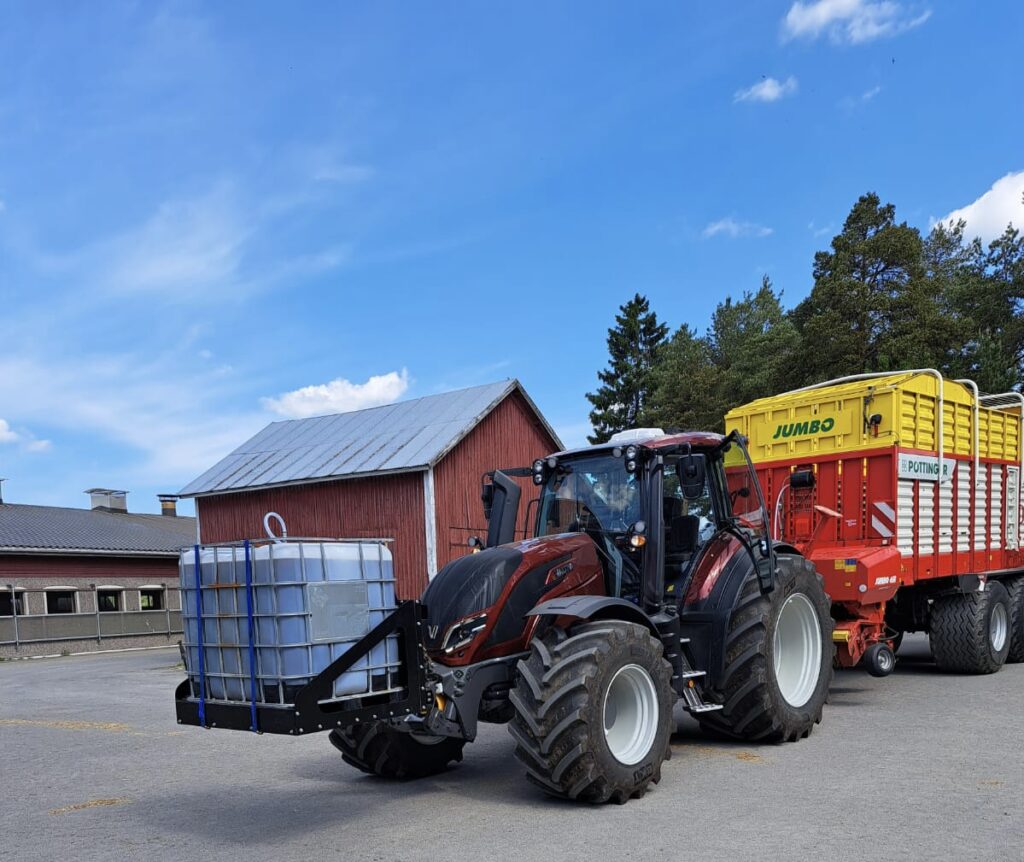
When you start using a new piece of plant or switch between machines (tractor ↔ wheel loader), carry out a quick risk assessment: where might the load strike, who is moving around the work area, and where there is a temptation to cut corners. If you’re looking for practical examples from everyday work, see also Transporting an IBC container safely on a tractor: the 7 most common mistakes and Water logistics in property maintenance are becoming more efficient, which emphasise the same principles through practical examples.
Safe IBC handling does not usually depend on the strength of the steel – but rather on ensuring that the securing method, centre of gravity and working method are the same and correct every time.
CE marking and documentation for IBC container racks: what should you request and what should you keep?
CE marking for an IBC container rack is only useful to the user if its “backing” is in good condition. At the very least, ask for the user manual and information on load capacities and compatibility. If the rack is part of a larger system (fittings, locks, hoses, nozzles, brush assemblies), ensure that each component is fit for purpose and that the instructions also specify any restrictions: for example, the permitted driving speed when loaded, the recommended filling level under certain conditions, or any additional safety measures required.
The practical value of these documents becomes particularly apparent when the work is carried out by several operators or by seasonal workers. Create a “site version” of the instructions: a single page or a laminated summary to be kept with the machine. Also, check that the sign/marking on the frame remains legible even after exposure to dirt and de-icing salt. When the marking fades, people often forget the limit values – and then decisions are made on a hunch.
A brief note
If the mount is being fitted for the first time or transferred to another machine, it is vital to take great care during the fitting process. Even a slight amount of play in the fitting can increase with vibration and impair control.
Lootu Oy (Pekurinpolku 3, 90450 Kempele) supplies racks designed for practical use with tractors and wheel loaders. When you purchase or start using a scaffold, make sure you establish clear operating procedures: who is authorised to use it, what training is required, and under what conditions it may be used. This is directly linked to health and safety – and also helps to minimise damage to equipment.
Load management, securing loads and visibility: an everyday checklist
When it comes to load control, an IBC container differs from, for example, a pallet load: the liquid moves and shifts the centre of gravity. For this reason, “adequate” securing is not just about preventing the container from falling, but also about limiting swaying and sliding. Use the locking mechanisms designed for the rack and ensure that the container is correctly positioned on the frame every time. If the container’s metal frame is bent or the base is damaged, it may sit at an angle and alter the behaviour of the entire load.
Visibility is an often-overlooked aspect of safety. When the tank is raised too high whilst driving, the driver’s field of vision is restricted, and at the same time the centre of gravity rises. Keep the load as low as possible whilst moving, adjust your speed to suit the condition of the site, and avoid sudden movements. When moving around in narrow yards or on building sites, always appoint a clear guide or agree on a “no one in front of the load” rule. In property maintenance, this is critical, as there may be bystanders in the area.
Daily pre-drive check This routine is suitable for both farms and property maintenance sites.
Anchorage points Check the locks, pins and bolts; look for any play and make sure nothing is only partially fastened.
Condition of the tank Any warping of the frame, cracks in the plastic or signs of leakage are grounds for ceasing use.
Hoses and valves Make sure that the hoses do not get pinched and that the valve is protected from impact.
Visibility and route Plan your route in advance: gates, potholes, ramps, pedestrian traffic and turning points.
Filling rate A half-full tank is likely to sway the most; consider the stage of the work and the conditions before setting off.
Responsibilities and roles: who is responsible for what in each usage scenario?
When it comes to scaffolding and machinery, responsibilities can easily become confused. It is the manufacturer’s responsibility to supply a safe product that complies with the relevant requirements for its intended use, and to provide adequate instructions. It is, in turn, the responsibility of the user and the employer to ensure that the equipment is used in accordance with the instructions, that users have received induction training, and that the working environment is properly managed. On a farm, this may also involve training a family member or seasonal worker; in property maintenance, it may involve coordinating subcontractors and site rules.
A particularly important point is “modification”: if you carry out your own welding, add extra brackets, drill holes or make adjustments to the scaffolding, or if it is used under a load that is completely different from that for which it was intended, the risks and liabilities increase rapidly. Any modification may affect the strength, load behaviour and validity of the instructions. If a modification is unavoidable for practical reasons, document it and assess its impact on safety before use.
Many practical problems are resolved by ensuring that the system remains “consistent”: the same frame, the same mounting parts, the same tank model and the same operating procedure. When the equipment varies (e.g. a tractor and a wheel loader on different days), always double-check compatibility. This topic is also touched upon in the article A tractor or a wheel loader for moving an IBC container?, which helps you choose the right method for your application.
Summary table: what should you check before use, and how often?
When inspections are scheduled, they are not left “to memory alone”. The following table serves as a basis for both the farm’s and the property maintenance team’s own maintenance and safety programme. Also, establish a written procedure: if any requirement is not met, work is suspended and the issue is rectified before proceeding. This is often the cheapest form of insurance for the whole season.
| Item to be checked | How often | What are you looking for / selection criteria |
|---|---|---|
| Fastening and locking mechanisms | Daily / before driving | No play, pins in place, locks fully engaged |
| Tank frame and base | Weekly + after every impact | No bends, cracks, leaks or deformities |
| The frame and welds of the scaffold | Monthly / at the start of the season | No cracks, rust pitting or deformation |
| Labelling and availability of instructions | At the start of the season + when there’s a change of users | The sign is legible; instructions can be found on the machine; induction has been completed |

If you want to take the routine a step further, include an “environmental check” in your inspection: the condition of the route, slippery patches, yard lighting and the boundaries of the work area. In property maintenance, the dark season and traffic pose a real risk; on a farm, on the other hand, slush and uneven verges are particular concerns. When these are included as part of the same checklist, potential hazards do not come as a surprise.
Three practical ways to improve safety straight away Small changes in everyday life can reduce major risks.
Standardise the rules of procedure The same route, the same lifting height and the same stopping point reduce errors.
Keep spare parts to hand It is advisable to keep quick-connect fittings, locking components and hose connectors in stock, so that a “temporary” solution does not become permanent.
Always provide guidance when necessary In tight spaces, a guide is an inexpensive safety measure – especially when visibility is reduced behind the load.
In conclusion: once the scaffolding is in good condition and the routines are in place, work proceeds more quickly and staff feel confident in handling loads in a controlled manner. This is precisely the concept behind Lootu Oy’s racks – a robust, safe and easy-to-install solution that caters for both the seasonal demands of farms and the day-to-day water logistics of property maintenance. If you want to ensure you choose the right model and mounting method for your machine, start by comparing the intended use and load: you’ll also find practical guidance on the page How to choose the right IBC container rack.
Would you like to make sure the stand fits your machine?
Let’s go through the intended use, load and method of attachment – and ensure safety in everyday use of a tractor or wheel loader.
Frequently Asked Questions
What does the CE marking actually mean in relation to an IBC container rack?
Who is responsible for safety once the scaffolding is already in use on a farm or in property maintenance?
Why is handling an IBC load more challenging than a standard pallet load?
What do I check before each transfer to ensure it is safe?
When should a rack or container be taken out of service and inspected more thoroughly?
Interested? Get in touch with us!
Please get in touch with us using the form below