

A tractor or a wheel loader for moving IBC containers? A comparison based on the application
When the task involves moving an IBC container, the choice between a tractor and a wheeled loader has a direct impact on how manageable, quick and safe the work is on a day-to-day basis. IBC containers are often used to transport water for washing and irrigation, preservatives or liquid fertilisers – and in such cases, the characteristics of the equipment and the design of the rack determine whether…

Voit jättää meille soittopyynnön
Jätä nimesi ja numerosi, niin soitamme takaisin saman päivän aikana.
When the task involves moving an IBC container, the choice between a tractor and a wheeled loader has a direct impact on how manageable, quick and safe the day-to-day work is. IBC containers are often used to transport water for washing and watering, preservatives or liquid fertilisers – and in such cases, the characteristics of the equipment and the design of the rack are crucial in ensuring that the entire assembly remains stable even on uneven ground, at a construction site or at the edge of a field. Lootu Oy (Kempele) manufactures sturdy, safe and easy-to-install metal IBC container racks, suitable for both tractors and wheel loaders – designed for practical work, not just ”on paper”.
This comparison looks at when a tractor-based solution makes the most sense and when a wheel loader offers a genuine advantage. We’ll focus on four factors that, in practice, determine success: manoeuvrability, working speed, safety and typical usage scenarios (farm work versus property maintenance). If you’d like to delve deeper into the pitfalls of tractor transport in particular, you might also want to read our related content: Transporting an IBC container safely by tractor: the 7 most common mistakes and how to avoid them.
A tractor or a wheel loader for moving IBC containers: factors to consider when making a decision
In many situations, both a tractor and a wheel loader are “capable” of moving an IBC container, but the best choice depends on the nature of the work. A tractor excels at long-distance movements, on varied routes and when the same machine has to perform several different tasks throughout the day. A wheel loader, on the other hand, is often unbeatable in tight yards, for terminal-style movements and in situations where precise positioning of the load and rapid repetition are crucial.
Also bear in mind this basic fact about IBCs: a typical 1,000-litre container can weigh over a tonne when full (depending on the density of the liquid), and the load behaves as a “live” mass during braking and cornering. That is why the rigidity of the rack, the method of securing the load and its position in relation to the vehicle’s centre of gravity are just as important as which vehicle you are driving.
The decision is guided by practical considerations Once you’ve answered these questions, the choice between a tractor and a wheel loader will quickly become clear.
Length of the route Is the IBC container being moved hundreds of metres or kilometres (by tractor) or just short distances around the yard (by wheel loader)?
Facilities and turning points Are there any narrow gates, loading bays, hall doorways or tight bends (for a wheel loader)?
Repetitive nature of the work Do you carry out “lots of lifting and positioning” (wheel loader) or “move and use” type transport (tractor)?
Fluid quality Is this a preservative or a fertiliser where the risk of splashing or spillage is particularly critical (with a strong emphasis on safety)?
The handling of an IBC container should always be viewed as a whole: machine + rack + securing + route + user procedures. Improving one aspect (e.g. a better rack) can enable safe working even when the equipment isn’t “perfect” for every situation.
Manoeuvrability and visibility: Moving an IBC container in confined and open spaces
When it comes to manoeuvrability, the wheel loader often has the edge, particularly in yard areas and warehouses. The steering joint, agile turning and the loader’s precise movement make it a strong choice when an IBC container needs to be lifted onto the edge of a pallet, positioned exactly in the right place or moved short distances several times. Visibility of the load is often good, which reduces the need to “guess” and helps to keep the load under control.
A tractor, on the other hand, performs well on longer routes and over varied terrain. The tractor can remain steady and stable overall, provided the load is correctly positioned and the driver adopts a proactive driving style. At the same time, it is important to recognise that the behaviour of the load can change when braking or encountering uneven ground, depending on whether the tractor is using its front loader or rear lift – particularly if the tank is nearly full and the liquid is able to shift around inside.

When assessing manoeuvrability, it’s also worth considering “stopping control”: how easily you can stabilise the load and lower it in a controlled manner without any jerks. The rigidity of the platform, its locking mechanisms and its compatibility with your specific machine’s mounting points play a major part in this. Lootu Oy’s design philosophy is specifically geared towards the practical demands of the job: the platform must guide the work towards stability, not require the operator to constantly compensate.
The safe transport of an IBC container is not a “trick”, but a routine to be followed consistently: a stable rack, secure fastening and a steady driving style make the risk manageable.
Work speed and efficiency: when does a wheel loader come out on top, and when is a tractor the better choice?
Work speed should not be measured solely in terms of driving speed, but rather as the entire work cycle: lifting, moving, positioning, unloading and the next cycle. In many property maintenance and contracting applications, the wheel loader is the fastest machine because it carries out “repeated transfers” smoothly. When water is transported to multiple points for sweeping and cleaning tasks, speed comes from manoeuvrability and precise positioning.
A tractor, on the other hand, may be the most efficient option when an IBC container needs to be transported over longer distances (e.g. to different sections of the farm or from the store to the edge of a field) and the same machine is used to carry out other tasks as well. The tractor also fits seamlessly into the daily routine of many farms: if the tractor is out and about anyway, it often makes sense to use it to move the IBC container as well – provided the rack and load securing are in order.
A brief note
When moving IBC containers is part of the daily routine, even small improvements to the rack’s suitability and ease of installation save time on every shift.
If the aim is to minimise the total time and the number of errors, compare it with your own work: how many movements per day, what sort of premises, and how much precise positioning is required. Often, the answer is surprisingly clear: “a wheel loader in the yard – a tractor on the track”.
Safety and risk management when transporting IBC containers
Safety is the most important aspect of this comparison, as IBC containers combine a large mass with the movement of liquid. A tip-over incident can be caused by surprisingly minor factors: a load positioned too high during transport, sudden braking, a side slope, or the rack failing to secure the container sufficiently. Furthermore, when handling preservatives and liquid fertilisers, the risks of splashes and spills are both a health and safety and an environmental concern.
Safety is particularly important when operating a tractor, especially when manoeuvring and on uneven ground. With a wheel loader, the risks often centre on lifting operations and manoeuvring in confined spaces – for example, near buildings, cars and pedestrians. For both machines, the safe transport of IBC containers is based on the same principles: keeping the load as low as possible, adjusting driving speed to suit the load’s behaviour, and ensuring that the rack is fit for purpose.
Safety procedures that reduce errors These are some simple checks to carry out before setting off.
Check the rack and the locks Ensure that the IBC container sits securely in the rack without any play and that it is secured in the intended manner using a “positive” locking mechanism (not relying solely on friction).
Keep the load low Carry the IBC as close to the ground as possible and avoid unnecessary lifting whilst moving it.
Anticipate braking and turns A “wave” in the fluid is caused by jerks. A steady pace is often more efficient than rushing about.
Keep your workspace tidy Set clear boundaries and avoid moving near people and vehicles without agreed procedures in place.
If you’d like more background information on IBCs and their standardised design, the Wikipedia article provides a good overview of this type of container: Intermediate bulk container. In practice, however, this knowledge only becomes tangible when the scaffolding, the machinery and the operating environment come together.
Typical use cases: farming vs. property maintenance
On farms, the transport of IBC containers is often linked to liquid fertilisers, preservatives and wash water – and routes may take in gravel tracks, farmyards and the edges of fields. In such cases, a tractor is the natural choice, as it is already in use and is well suited to varied terrain. Lootu Oy’s water tank for a tractor - These solutions place particular emphasis on durability and practicality in Finnish conditions: the frame must not move, warp or require constant adjustment.
In property maintenance and contracting, on the other hand, the nature of the work often involves “point-to-point” logistics: water for sweeping, washing and dust suppression, and the work area can be confined, busy with traffic and subject to tight schedules. A wheel loader offers the advantage of agility and the ability to position loads quickly. If, for example, you carry out maintenance on streets and courtyards, it’s also worth taking a look at the content water for brushing as well as the logistics sector as a whole: Water logistics in property maintenance are becoming more efficient.
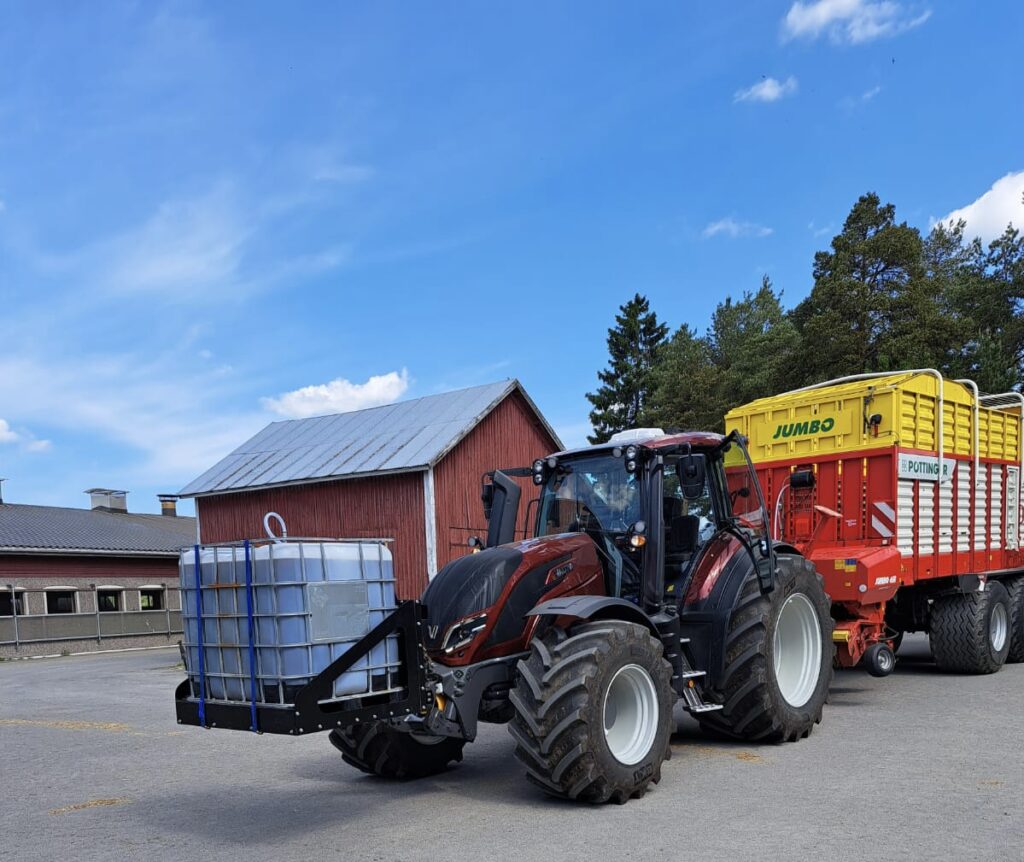
Once the application scenario is clear, choosing the right rack becomes easier. For preservative solutions, the focus is on chemical control and the rack’s secure support. For brushing and washing solutions, on the other hand, the emphasis is on speed of use and repeatability: filling, moving and using the equipment without any unnecessary “tinkering”. Lootu Oy’s racks are designed to suit both worlds – the rhythm of farm life and the schedules of property maintenance.
Summary: How to choose the right machine and rack for moving IBC containers
When comparing a tractor and a wheel loader, don’t base your decision solely on personal preference or on which one “just happens to be in the yard”. You’ll get the best result when you consider the equipment in relation to the route, the premises and the frequency of the work cycle. A tractor is often the most sensible choice when journeys are longer, the terrain varies and the same machine serves multiple purposes. A wheel loader offers advantages when the work is cyclical, carried out in confined spaces and requires quick, precise positioning.
| Point of reference | Tractor | Wheel loader |
|---|---|---|
| Typical strength | Longer transfers and versatility on the farm | Agility, visibility and repeated transfer cycles in the yard |
| Manoeuvrability in tight spaces | Moderate (depending on the configuration) | Good (articulated steering and precise loader) |
| Overall work rate | It’s good when the route is long and the work involves “move and use” | It’s good when there are plenty of lifts and set-ups |
| Safety priorities | Driving style, low-load transport and route gradients | Lifting, positioning close to structures and control of the work area |
Ultimately, moving an IBC container is a system: machine + rack + fixings + the operator’s way of working. If one part is weak, the whole chain is vulnerable to errors. That is why it is worth taking a moment to choose the right rack – especially if you frequently move full containers or work in environments where the safety margin is small.
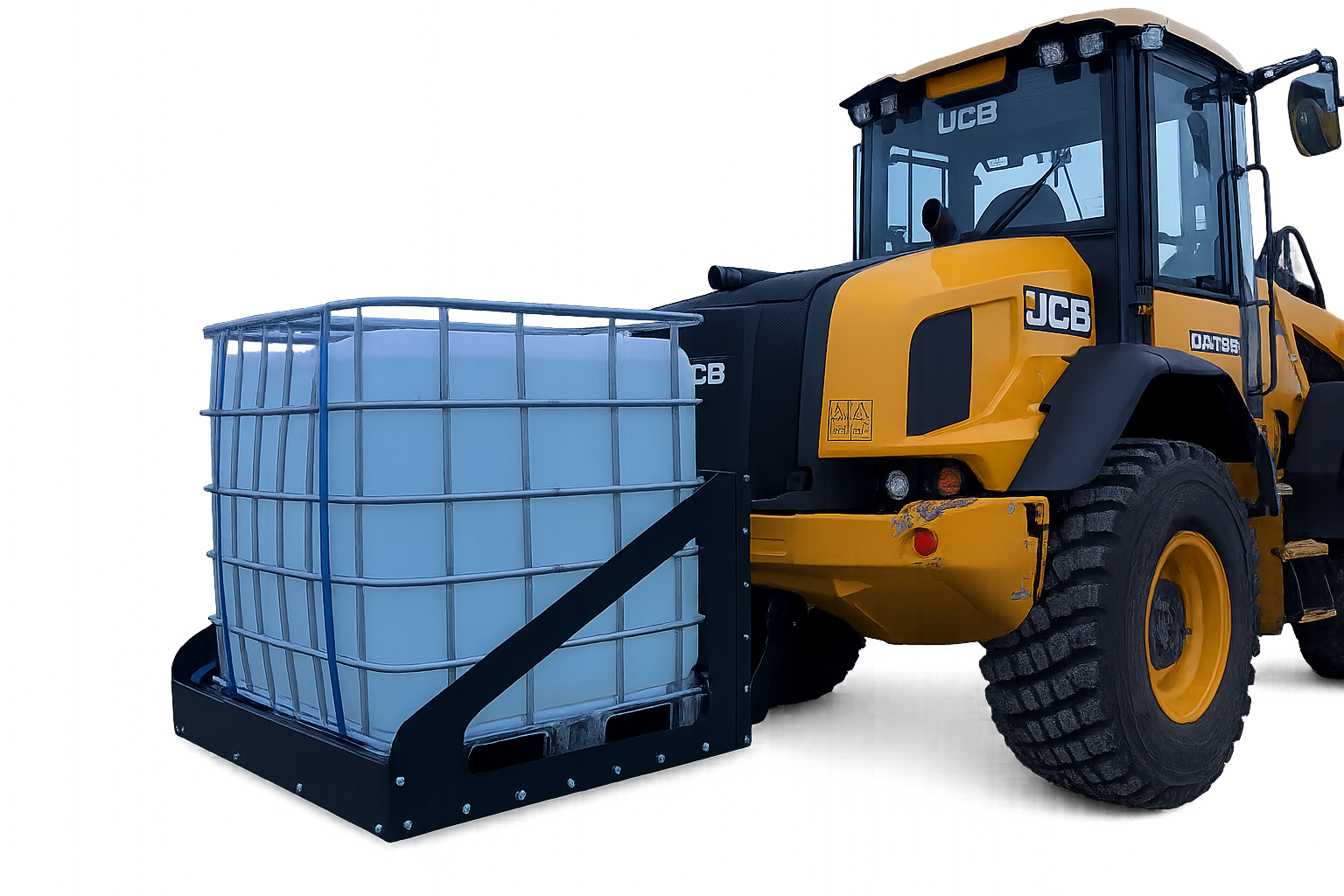
If you want to ensure that the solution is suitable for your specific equipment and application (farm or property maintenance), Lootu Oy can help you make the right choice and supply robust, safe and easy-to-install racks for IBC containers. You can find further information and contact details for our Kempele branch (Pekurinpolku 3, 90450 Kempele) on the page Contact details – or find out more here products and choose a rack that makes moving items a routine task.
Are you looking for a secure and stable rack for your IBC container?
Tell us what you’ll be using it for (a farm or property maintenance) and what equipment you have – Lootu Oy will help you choose a rack that makes moving items safe and smooth.
Frequently Asked Questions
Which is safer for moving an IBC container: a tractor or a wheel loader?
Why does the IBC container seem to “sway” when braking and cornering?
When is a tractor-based solution the most sensible choice for moving an IBC container?
When does a wheel loader offer a clear advantage when handling IBC containers?
What information should you provide when requesting a quote for an IBC rack?
Interested? Get in touch with us!
Please get in touch with us using the form below