

Transport and use of IBC containers in property maintenance in Vaasa and Kokkola: efficiency in sweeping and cleaning work
In coastal towns such as Vaasa and Kokkola, the transport and use of IBC containers in property maintenance is often that small but crucial factor that distinguishes a smooth working day from a frustrating one full of adjustments. When sweeping and washing tasks are carried out on the move from one site to another, the water supply must operate on the same principle: water flows where…

Voit jättää meille soittopyynnön
Jätä nimesi ja numerosi, niin soitamme takaisin saman päivän aikana.
Transport and use of IBC containers in property maintenance In coastal towns such as Vaasa and Kokkola, it is often that small but crucial factor that distinguishes a smooth working day from a frustrating struggle. When sweeping and washing tasks are carried out on the move from one location to another, the water supply must operate on the same principle: water goes where the work goes. This article outlines a practical model that improves water logistics, reduces travel time and ensures a consistent standard of work, even when schedules are subject to change.
Lootu Oy (Pekurinpolku 3, 90450 Kempele) is a Finnish manufacturer of metal products that develops and supplies robust, safe and easy-to-install IBC container racks for tractors and wheel loaders. When the rack and tools are specifically designed with practical work in mind, the IBC container becomes more than just a storage solution in property maintenance: it becomes an integral part of production and day-to-day operations.
Why is the transport and use of IBC containers in property maintenance a particular focus in Vaasa and Kokkola?
In Vaasa and Kokkola, sites may range from city centres to harbour areas and industrial yards, where the need for washing and brushing varies from day to day. At one site, light dust-binding brushing may suffice, whilst at another, a fair amount of water is required for the washing equipment. When the water supply is tied to a fixed refill point, “hidden journeys” easily creep into the working day: driving back to refill, waiting around and reorganisation.
An IBC tank (typically in the 600–1,000-litre range) is practical for property maintenance, as it combines a large water capacity with reasonable manoeuvrability. When the tank is transported on a tractor or wheel loader in a secure rack, several courtyards, entrances, car parks or loading bays can be serviced in a single trip. This allows site management to respond to changes without every change necessitating a reorganisation of the water logistics.
Typical situations where water logistics make a difference With a water supply in place, you can keep the work going without any unnecessary interruptions.
Brushing on dusty surfaces Light watering improves the end result and reduces dust nuisance.
Cleaning up after the building site Concrete and soil splashes come off more effectively when there is a steady supply of water.
Multi-site tour The same fleet serves several locations without the need for constant refuelling.
Changes to timetables When the site changes during the day, the water supply remains on schedule.
Standardisation also underpins the IBC solution: when you use a single, clearly defined container format and adapt it to the rack, hoses and pump, day-to-day operations become more predictable. If you’d like some background on the basic concepts, you can find a general overview of the IBC container on Wikipedia, for example: Intermediate bulk container.
A basic water supply model for brushing and washing tasks: filling, transport, use
An effective water supply system for mobile work consists of three stages: sensible filling, safe transport and smooth operation on site. During the filling stage, it is worth ensuring that there is a clear routine in place: where to fill up, which connectors to use, and who is responsible for ensuring that the tank is “ready to go”. The less improvisation there is, the less time is spent fiddling about in the yard.
The rack plays a key role during transport. An IBC container filled with water is very heavy, and controlling its centre of gravity affects both safety and the machine’s manoeuvrability. Lootu Oy’s water tank racks for tractors are designed to withstand demanding use in Finnish conditions and to facilitate attachment without the need for special tools. When the rack is stable, the driver can concentrate on the route and does not need to worry about “live” loads with every bump in the road.
The third stage is on-site use: water metering and pacing the work. When brushing, the typical requirement is controlled, even wetting to bind dust; when washing, on the other hand, a momentarily higher flow rate is required. It is therefore advisable to consider the tank’s fittings (e.g. hose, valves, a possible pump and nozzle) in advance, based specifically on your own work requirements, rather than opting for a one-size-fits-all solution.
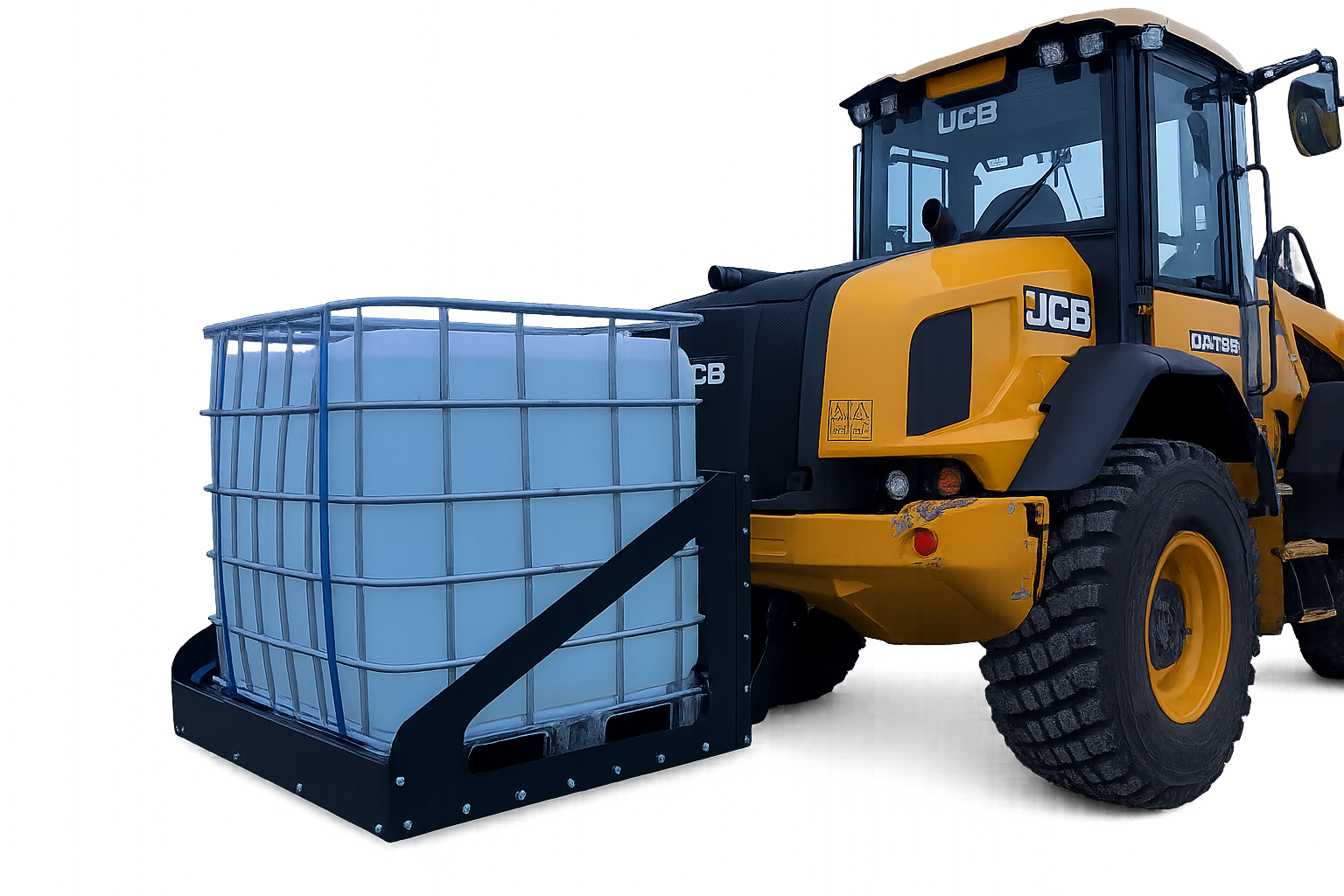
When everything is in order, a single tank of water can be used to clean several areas before it needs refilling. This is directly reflected in the efficiency of the work: less driving, less waiting and more “productive time” with the brush and washing equipment.
In mobile property maintenance, water is not an expense but a prerequisite for production: as long as there is water, work can continue and quality remains consistent.
Transport and use of IBC containers in property maintenance: safety and procedures on coastal routes
Transport and use of IBC containers in property maintenance requires both common sense and clear routines. In the Vaasa and Kokkola regions, routes often involve driving through built-up areas, site traffic and varying yard conditions. A full IBC container reacts to movements: braking, turning and uneven surfaces. That is why securing the rack, locking the load and adhering to the limits set out in the machine’s operating instructions form the basis of everyday safety.
It is good practice to carry out a “pre-departure check” using the same checklist every time: is the tank intact, is the valve closed, are the attachment points secured, and is the hose protected so that it does not get caught on the tyres or the corners of the chassis? When the check is routine, it does not slow down the work but reduces the number of surprises. If you wish to explore the risks involved in transport in greater depth, the subject is also covered in an article by Lootu Oy, which is well worth reading to supplement the work instructions: Transporting an IBC container safely on a tractor: the 7 most common mistakes.
Quick safety checks before you set off These points are easy to check, but they have a significant impact.
Fastening and locking Make sure that the rack’s locking mechanisms are in place and that the load cannot move.
Valve and fittings Check that there are no leaks from the valve and that the connector is protected from splashes and impacts.
Focus and visibility Position the tank so as to ensure that the machine remains manoeuvrable and the driver’s field of vision is not obstructed.
Driving style Plan your route and keep your speed under control, particularly at junctions and on uneven ground.
When safety is assured, operations on site run smoothly: the driver can be confident that the tank will remain stable and can focus on the quality of the wash or brush-down. This is particularly important during busy periods, when “extra” jobs or sudden windows of good weather may arise during the working day, which are worth taking advantage of.
A tractor or a wheel loader? Efficiency depends on the job and the route
In property maintenance, the choice of machinery is not merely a matter of preference; it has a direct impact on how quickly water can be delivered to the right place. A tractor is often a good choice for longer journeys and when the route includes sections on public roads or through built-up areas. A wheel loader, on the other hand, may be at its best in situations where precise manoeuvring, loading or repeated short journeys within the grounds are required.
In the Vaasa and Kokkola area, you may encounter both situations on the same day: first, sweeping and light watering across a large outdoor area, then cleaning at an industrial site where tight turning circles and confined spaces are key considerations. As the IBC tank and rack are compatible with both a tractor and a wheel loader, the equipment can be selected according to the day’s tasks without having to reconfigure the water supply system each time.
| Selection criterion | Tractor | Wheel loader |
|---|---|---|
| Moving between locations | Good on longer journeys and on varied road surfaces | It works, but is at its best for short journeys |
| Working in confined spaces | It depends on the equipment and the space available; manoeuvrability may be more limited | Often agile and precise when close to the target |
| Water consumption during work | Easy to combine with brushing and maintenance accessories | Suitable if the work is “yard-based” and the water requirements vary from site to site |
| The allocation of equipment throughout the day | A versatile all-round machine that can also be used for transport | Effective for targeted work and material handling |
If you would like to read a more in-depth discussion on choosing a machine for different applications, this topic is explored in an article by Lootu Oy: A tractor or a wheel loader for moving an IBC container?. When the decision takes into account the route, the condition of the site and the working method, water management becomes part of production optimisation, rather than a separate concern.
Practical equipment for brushing and washing tasks: dispensing, hosing down and the rhythm of the work
When the aim is smooth scrubbing and washing, the “amount of water” alone is not enough. What matters is how the water is released from the tank in a controlled and safe manner. For many property maintenance teams, the most effective set-up consists of a clear hose connection, an easily accessible valve and a nozzle or distribution system suited to the task: a light, even flow for brushing and, where necessary, a higher flow rate for washing.
In terms of the rhythm of the work, it is also worth considering the fill level: it is not always sensible to fill the tank completely if the day’s destinations are close to the refill point or if flexibility is required. On the other hand, on coastal routes and when visiting scattered locations, a full tank reduces the number of return journeys. In practice, the best approach is to monitor, over a period of one to two weeks, how much water is actually used per site and how consumption is split between brushing and washing.

When the equipment has been carefully planned, the quality of the work improves too: dust is not scattered, the cleaning results are more consistent and the workload on staff is reduced. At the same time, there is less need to improvise by finding a water source on site, which improves health and safety and the customer experience.
A brief note
If you find that water supply tasks always seem to get pushed to the back of the queue during the working day, start simple: draw up a standard template for filling, transport and commissioning checks. Once the basic process is up and running, it’s easy to develop your equipment further.
See a practical example of how to use irrigation water for brushing
Lootu Oy’s racks as part of water logistics: durability, ease of installation and versatility
Lootu Oy’s strength lies in its understanding of practical work: the scaffolding must withstand vibrations, changes in weather and repeated use without turning day-to-day operations into a constant series of adjustments. In property maintenance, the advantage of the rack is clearly evident in the fact that the IBC container remains stable and the machine remains easy to control. This reduces risks and also makes it easier to plan the work, knowing that the water supply is reliably maintained.
Versatility is particularly important for contractors and property maintenance providers who serve multiple clients in different locations. The same rack and container solution can be used for brushing and washing, as well as for other liquid transport and storage needs. Lootu Oy also manufactures preservative racks for agricultural use, which reflects the design philosophy behind its structures: a stable base, secure fastening and ease of use in everyday work.
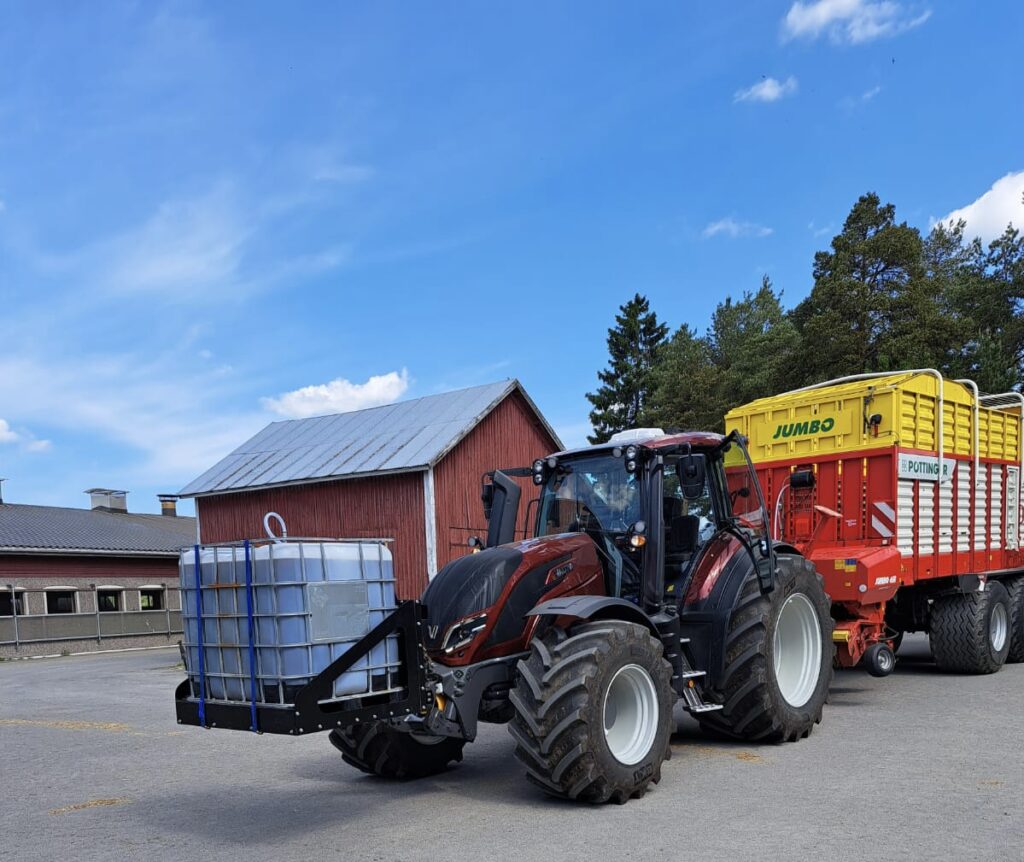
If you are considering a purchase or want to compare options, start by looking at the product-specific information and areas of application. Good places to start are Water tank for a tractor and, more generally, Products. When the overall system is designed to suit your own operations, the transport and use of IBC containers in property maintenance changes from an ad hoc solution to a systematic approach.
In conclusion: whilst the pace of work in coastal towns often varies, water management need not. Once filling, transport and use have been standardised and the rack has been designed for the job at hand, brushing and washing tasks can be carried out without any unnecessary interruptions. Further information and contact details for Lootu Oy can be found on the website Contact details (tel. 050 374 7690, [email protected]).
Would you like to improve water management on construction sites?
Please tell us what sort of cleaning and washing jobs you carry out in Vaasa, Kokkola or the Oulu region. We’ll help you find a scaffolding and water logistics solution tailored to your practical needs.
Frequently Asked Questions
Why is an IBC container a good solution for cleaning and scrubbing tasks in property maintenance?
How can you ensure the safe transport of an IBC container using a tractor or a wheel loader?
How much water should be set aside for work on outdoor areas in Vaasa and Kokkola?
When is a tractor better, and when is a wheel loader with an IBC container the better option?
How does Lootu Oy’s IBC container rack benefit property maintenance?
Interested? Get in touch with us!
Please get in touch with us using the form below