
IBC container racks in Kempele and the Oulu region: the most common applications on farms and in property maintenance
IBC container racks in Kempele and the Oulu region offer many farms and property maintenance companies a practical way to streamline the transport, use and storage of water and other liquids. In Northern Ostrobothnia, working days are often spent in windy and rainy conditions and with fluctuating temperatures – which is precisely why the rack’s stability, mounting solutions and ease of maintenance…

Voit jättää meille soittopyynnön
Jätä nimesi ja numerosi, niin soitamme takaisin saman päivän aikana.
IBC container racks in Kempele and the Oulu region For many farms and property maintenance companies, it is a practical way of optimising the transport, use and storage of water and other liquids. In Northern Ostrobothnia, work is often carried out in windy and rainy conditions and in fluctuating temperatures – which is precisely why the stability of the rack, its mounting solutions and ease of maintenance are so important. Lootu Oy (Pekurinpolku 3, 90450 Kempele) manufactures sturdy, safe and easy-to-install metal IBC container racks for tractors and wheel loaders, ensuring that day-to-day transport operations are not slowed down by uncertainty or unnecessary manual labour.
Once an IBC container has been lifted, secured and handled safely on the rack, the rhythm of the work changes: less adjustment is needed in the yard, there is less spillage, and there is greater predictability, even on construction sites. This article examines, from a local perspective, where the rack is most beneficial in Kempele and the Oulu region – and what to bear in mind when weather conditions, construction sites and machinery vary.
In what ways do IBC container racks in Kempele and the Oulu region contribute to day-to-day efficiency?
In the Oulu region, machinery often moves from yard work to the edges of fields and from there to construction sites within the same day. The value of an IBC container rack becomes particularly apparent when the same container is used for multiple purposes: irrigation water, washing water, cleaning water or, for example, the handling of preservatives. When the tank remains securely in the rack, the number of journeys does not in itself decrease – but the quality of the journeys improves: the work is more controlled and driving is safer.
In property maintenance, a water tank is particularly useful at sites where water is not immediately available or where it takes a long time to lay out hose lines. In the maintenance of streets and courtyards, as well as on construction sites, water is often needed “in small quantities but repeatedly”: for dust suppression, to aid sweeping, for washing, watering courtyards and rinsing tools. On farms, too, the same basic principle applies: water for washing in the barn, water for irrigating crops, and liquid fertilisers or preservatives applied to the right place at the right time.
The most common everyday situations In this sort of work, the benefits of using a scaffold quickly become apparent in the form of time saved and a more organised approach.
Brushing and dust control Water is dispensed more evenly when the tank is stationary and the hoses are arranged sensibly.
Washing and rinsing Water for washing is available on the premises or at the site without the need for separate storage tanks or carrying it from elsewhere.
Watering and refilling runs Movements between fields, greenhouses or garden areas are controlled even on uneven ground.
Handling of preservatives A stable platform reduces the risk of splashes and falls when working in conditions involving pressure, vibration and adverse weather.
The most common uses on farms: water, washing and liquids, all using the same frame
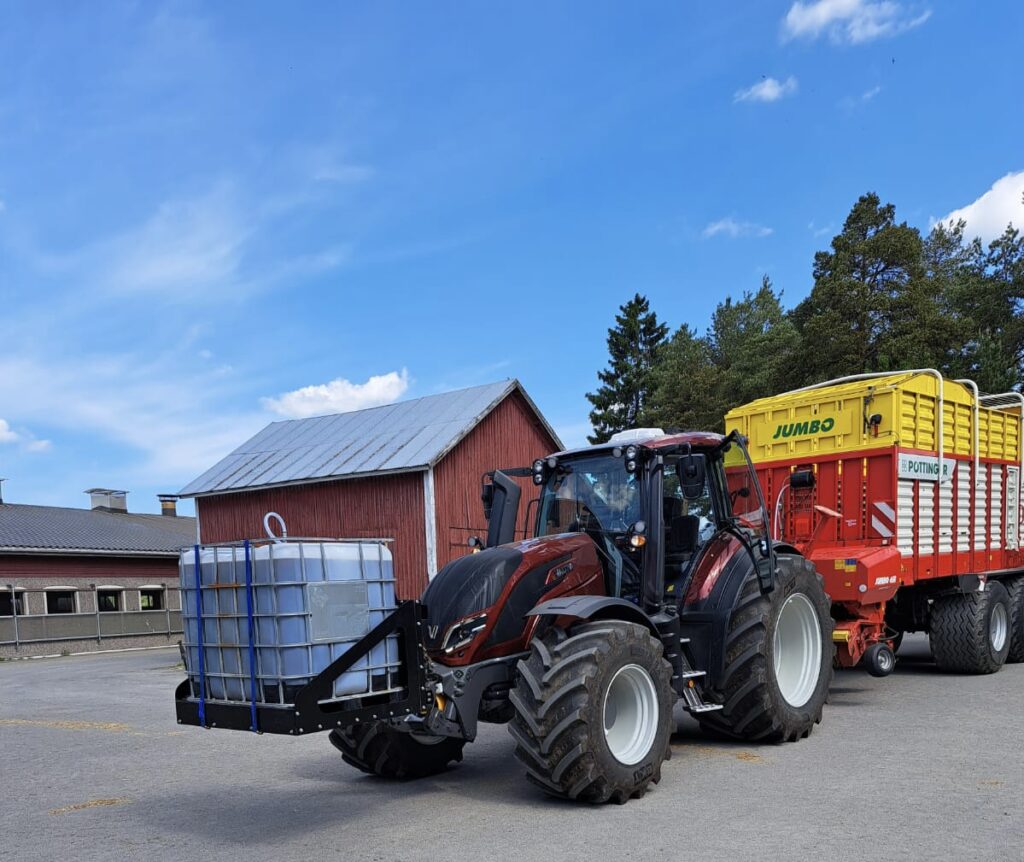
On farms, an IBC container is already versatile in its own right – but the rack really turns it into a “tool attached to the machine”. Typical uses include transporting water for irrigation, supplying water for washing in the farmyard or production areas, and the transport and handling of various liquids. When the tank is mounted on the frame, transport is more stable, and it is easier to protect and secure the tank in a consistent, repeatable manner.
In the Oulu region and in Kempele, the daily life on farms is also characterised by its seasonal nature: watering and cleaning in spring and summer, the rhythm of the harvest in autumn, and varying maintenance needs in winter. The rack should be designed to accommodate this variation – in other words, it should be suitable for the actual machinery (tractor or wheel loader) and the relevant routes (courtyards, gravel tracks, field edges). If you’d like to gain a deeper understanding of the overall use of IBC tanks from a farm’s perspective, have a look at the article An IBC container on a farm: a versatile solution.

When transporting water or other liquids, safety and practical routines are crucial. An IBC container is heavy even when empty, and when full, its mass becomes particularly noticeable on uneven ground. It is therefore worth ensuring that the rack’s fixing points are clearly marked, the locking mechanism is secure and the whole assembly is easy to check before setting off. Further reading on common mistakes and how to avoid them can be found in the article Transporting an IBC container safely on a tractor.
Property maintenance and contracting in the Oulu region: when water needs to be supplied to the site in a sensible way
In property maintenance, the problem is often not that there is no water – but that it is in the wrong place at the wrong time. When water is needed on site for washing or watering, the options are typically slow hose connections, temporary containers or several separate trips. An IBC tank mounted on a rack makes water logistics predictable: the water is on hand and can be used on site in a controlled manner without the need for constant moving around.
Distance and the need to move between sites are also key factors in the Oulu region: today a courtyard in Kempele, tomorrow a job in Liminka, and at the weekend possibly somewhere along the Raahe–Tyrnävä corridor. That’s why the “day-to-day practicality” of the frame lies in the fact that its assembly and use don’t require any specialised tools or hard-to-remember tricks. If transporting water and on-site use are key considerations for you, do have a look at Water logistics in property maintenance are becoming more efficient.
Once the tank is properly secured on the rack, things calm down on site: fewer hasty decisions, more controlled work, whatever the weather.
Practical benefits of on-site use In property maintenance, even minor improvements are carried out many times throughout the day.
Faster transitions As the water is supplied on site, there is no need to wait for it to be filled up or to arrange temporary solutions.
A neater finish Controlled hosing and a stable tank reduce splashing and the need for “puddle logistics” in gardens.
Safer handling A stable stand helps to keep your centre of gravity under control on uneven ground and when turning.
Repeatable routines When the way things are used is similar from one location to another, induction becomes easier and errors are reduced.
Changing weather and site conditions in Northern Ostrobothnia: what should you look for in scaffolding?
In the conditions found in the Kempele and Oulu regions, the same job may begin on a dry gravel yard and end in the rain on soft grass. In winter, there is the added challenge of slippery conditions, the effect of cold spells on materials, and icy surfaces, where the fastenings may take longer to secure. Therefore, when selecting an IBC container rack, it is not enough to simply consider whether “the container fits”; one must also assess how the rack behaves under vibration, lateral movement and constant temperature fluctuations.
Practical requirements include, for example, clear and sturdy attachment points, a structure that supports the container evenly, and the ability to check the locks quickly before setting off. Ease of maintenance and inspection are also part of safety: when using a metal product that is exposed to salt, moisture and knocks, a little foresight can save you from major surprises. General information on IBC containers can be found, for example, on Wikipedia: Intermediate bulk container.
A brief note
If the operating environment varies from a garden to a construction site, the choice of scaffold should be based on the load, the fixings and the machine – not just on the size of the tank.
A tractor or a wheel loader, a water tank rack or a preservative rack? A clear comparison to help you make a decision
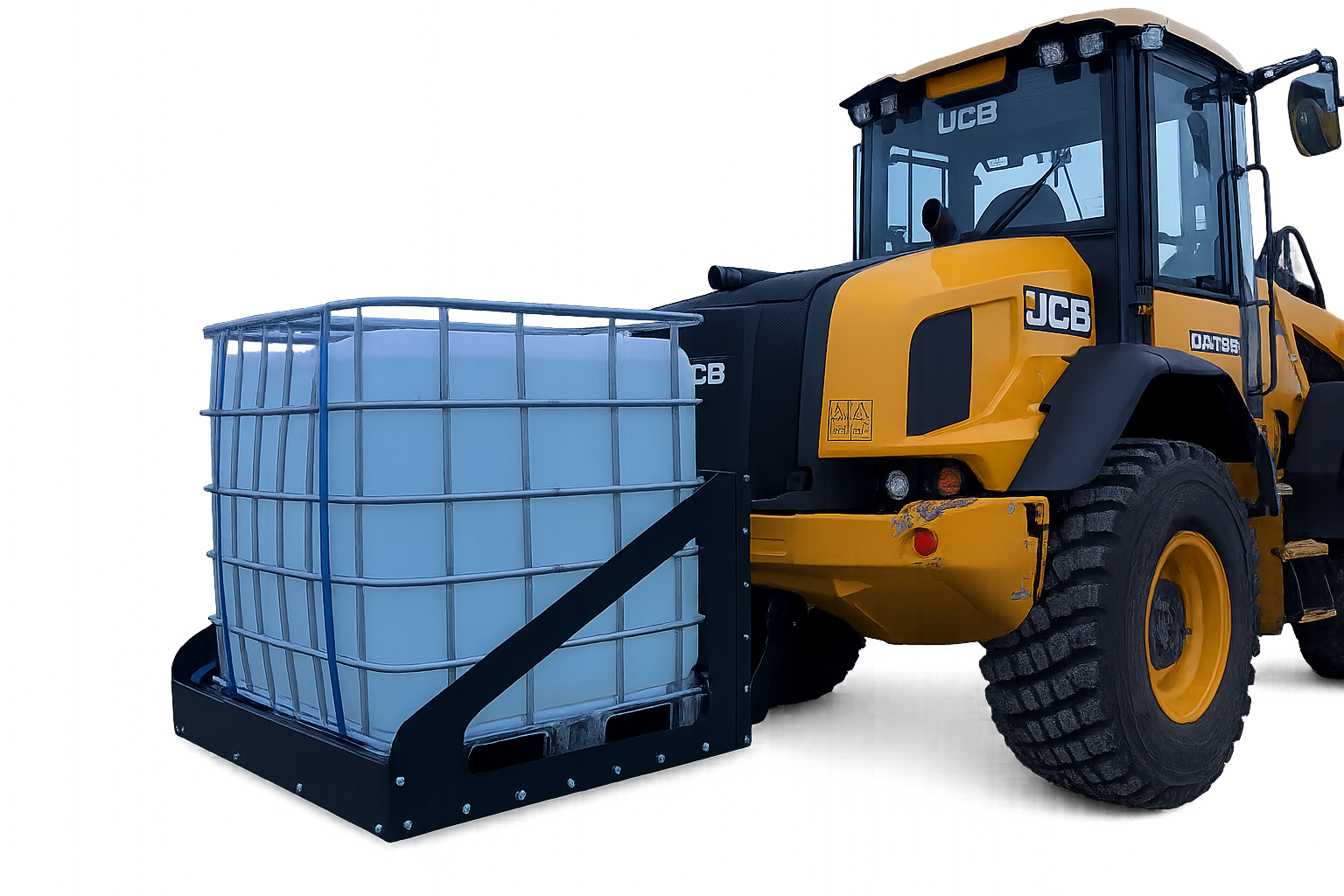
The right combination depends on how the liquids are actually used: is water being transported for washing, is washing water always required, or are preservatives being handled, in which case a safe and stable base is critical? From Lootu Oy’s perspective, the rack is specifically a tool for the machine – and therefore the choice should be made according to the machinery, work sites and recurring work stages. If both a tractor and a wheel loader are in use, it may be sensible to define the “primary use” and ensure that the mounting and manoeuvrability are natural for that particular machine.
The comparison below will help you approach your choice in a practical way. It is always worth checking the exact specifications and intended uses based on the requirements of your own work, but the table provides a quick framework for discussion and for justifying your purchase.
| Application | Recommended solution | Why does it work in the Oulu region? |
|---|---|---|
| Sweeping of courtyards and street areas, dust suppression | Watering can for brushing the rack | The water flows from one location to another, and its use remains under control even on uneven surfaces. |
| Washing and watering tasks on the farm | Water tank rack for a tractor | Repeated journeys between the yard and the fields are made easier when the coupling is standardised and the check is quick. |
| Preservatives and other demanding liquids | Preservative rack (tractor/wheel loader) | Stable support reduces the risk of splashing and tipping in the event of vibrations and changes in weather conditions. |
Once the decision has been made, the next step is to ensure that it works smoothly in everyday use: where the hoses are stored, how they are filled, and how the driver ensures that they are secured in exactly the same way every time. Simplicity is key in these matters – especially when the working day starts early and the weather changes whilst on the road.
Commissioning and maintenance: how to ensure safe operation year after year
Even the best rack won’t do the job on its own if its implementation is left half-finished. Once the use of IBC container racks in Kempele and the Oulu region becomes part of the routine, it is worth taking a moment at the start to ensure that staff agree on a common checklist: what to check before driving off, at what stage to ensure the container is securely locked, and how to report any damage. In contract work in particular, consistency equals efficiency: when everyone follows the same procedures, risks are reduced and the equipment remains in better condition.
Maintenance focuses on cleaning, visual inspections and monitoring of wearing parts. In the north, dirt, sand and moisture find their way into the fastenings, and during the winter season, ice and road salt increase the load. Regular washing and inspection are quick measures compared to having to stop using the scaffolding at the busiest time of year. You can read more about maintenance and extending the service life here: Maintenance and inspections.
A quick pre-drive check By keeping these basics in mind, you’ll avoid the most common surprises in changing conditions.
Locks and fastenings Before setting off, make sure that all locks are properly secured and that the attachment points are intact.
Condition of the tank Check that the tank has no cracks, leaks or suspicious dents.
Hoses and valves Make sure the hoses are securely fastened and the valves are closed to prevent splashing whilst driving.
Platform and route Assess the access road, the softness of the site and the turning points; avoid sudden manoeuvres when fully laden.
Once the rack, tank and routines are in place, the system will serve you well for a long time, both on the farm and in property maintenance. Lootu Oy’s advantage as a local operator is that its products are designed to meet the practical needs of the job in Finnish conditions – and, based in Kempele, it is easy to serve the Oulu region and other locations (Vaasa, Joensuu, Kuopio, Liminka, Tyrnävä, Raahe, Kajaani, Kokkola). If you’re wondering which solution would be best suited to your particular machine and your specific needs, taking a look at our ready-made products and installation instructions will save you time even before your first day’s work.
Do you need help choosing the right attachment, or do you want to make sure the solution is compatible with your tractor or wheel loader? Lootu Oy is here to help – you can find us in Kempele at Pekurinpolku 3, 90450 Kempele, by telephone on 050 374 7690 or by email at [email protected].
Do you need a scaffold that can withstand proper work?
Tell us about your machinery and how you intend to use it, and we’ll help you choose a safe and efficient IBC racking solution for the Oulu region.
Frequently Asked Questions
What are the best uses for an IBC container rack in the Oulu region?
What should you bear in mind in winter and in changeable weather in Northern Ostrobothnia?
Is a tractor or a wheel loader better for moving IBC containers?
Can the same IBC container be used for both washing and watering?
How do I choose the right rack from Lootu Oy for my own use?
Interested? Get in touch with us!
Please get in touch with us using the form below