

Calculating the weight and load of an IBC container: how to correctly size the rack, tractor and attachments (examples: 600–1000 l)
It is surprisingly easy to estimate the weight of an IBC container once you break down the total mass into three parts: the container itself, the liquid inside the container, and the mass of the rack and accessories. By adding these together and relating them to the loads involved in lifting, driving and securing the container, you can avoid the most common mistakes: an undersized frame, front-axle lift…

Voit jättää meille soittopyynnön
Jätä nimesi ja numerosi, niin soitamme takaisin saman päivän aikana.
IBC container weight It is surprisingly easy to estimate once you break the total mass down into three parts: the tank itself, the liquid inside the tank, and the mass of the rack and accessories. When these are added together and weighed up against the loads involved in lifting, driving and securing the load, you’ll avoid the most common mistakes: an undersized frame, front-axle lift-off, or the lifting equipment’s capacity being “sufficient on paper” but proving inadequate in practice on uneven terrain.
This article walks you through the calculations using examples of 600–1,000 litres, whilst also explaining what the figures mean in terms of tractors, wheel loaders and accessories (hoses, pumps, valves, guards). Lootu Oy (Kempele) manufactures safe IBC container racks suitable for everyday use, drawing on its expertise in metal products – but the aim of this text is not to serve as a selection guide, but rather to provide a clear dimensioning logic that will help you assess the load correctly even before purchase and commissioning.
IBC container weight: what makes up the total mass?
The total mass is not just “1,000 litres of water”, but in practice tank + liquid + accessories + stand. A typical IBC container (1,000 l) consists of a plastic tank and a metal cage, and even when empty it weighs roughly tens of kilograms. When you add the rack (steel structures, mounting brackets, a protective arch if required) and the equipment needed for the job (hoses, couplings, a pump, a filter), the total weight quickly rises to “over a tonne”.
The basic formula that allows you to quickly work out the correct order of magnitude is:
Total mass (kg) = IBC container (kg) + liquid (kg) + rack (kg) + accessories (kg)
The mass of a liquid can be estimated using its density: mass = volume × density. The density of water is close to 1 kg/l (approximately 1000 kg/m³), so “1000 l of water” is, in practice, approximately 1000 kg. If you are transporting other liquids (e.g. liquid fertilisers or preservatives), the density may differ from that of water – it is therefore advisable to check the density (kg/l) in the product’s safety data sheet or technical data sheet. A general definition of density can be found, for example, on Wikipedia: Density.
A quick checklist for assessing pulp When you measure the load for the first time, use the same frame each time and record the result in the machine-specific notes.
Start with the liquid 600 litres of water ≈ 600 kg, 1,000 litres of water ≈ 1,000 kg.
Add “packaging” An IBC + rack often weighs well over 100 kg in total.
Other work equipment The hoses, pump and guards add weight and shift the centre of gravity.
Estimate the dynamic additional load Braking, potholes and inclines increase peak loads.
When discussing dimensioning, “dynamic load” is also an important factor to consider. During driving, the fluid moves (”sloshes”), and bumps momentarily increase the load on the rack, mountings and chassis. Therefore, a static weight rating alone is not sufficient, even though it is always the starting point.
Sample calculations for 600–1000 l: The weight of 1000 l of water in practice
Below is an indicative comparison illustrating how quickly the total mass increases. The entries “Empty IBC”, “rack” and “accessories” in the table are examples; in practice, weighing the items or referring to the manufacturer’s specifications will provide a more accurate figure. However, the calculation is straightforward when using water, and therefore the “weight of 1,000 litres of water” serves as a good reference for other liquids as well (correction for differences in density is simply a matter of applying a conversion factor).
| Volume | Liquid (kg) | Empty IBC (kg) | Rack + accessories (kg) | Estimated total mass (kg) |
|---|---|---|---|---|
| 600 l | ≈ 600 | ≈ 55–70 | ≈ 90–180 | ≈ 745–850 |
| 800 l | ≈ 800 | ≈ 55–70 | ≈ 90–180 | ≈ 945–1050 |
| 1,000 l | ≈ 1,000 | ≈ 55–70 | ≈ 90–180 | ≈ 1145–1250 |
The table highlights two practical conclusions. Firstly: even if you’re “just carrying water”, a 1,000-litre load easily weighs 1.15–1.25 tonnes when you include the rack and work equipment. Secondly: even loads of 600–800 litres often come close to a tonne, which significantly affects handling and lift control, particularly if the load is positioned high up or outside the machine’s chassis.
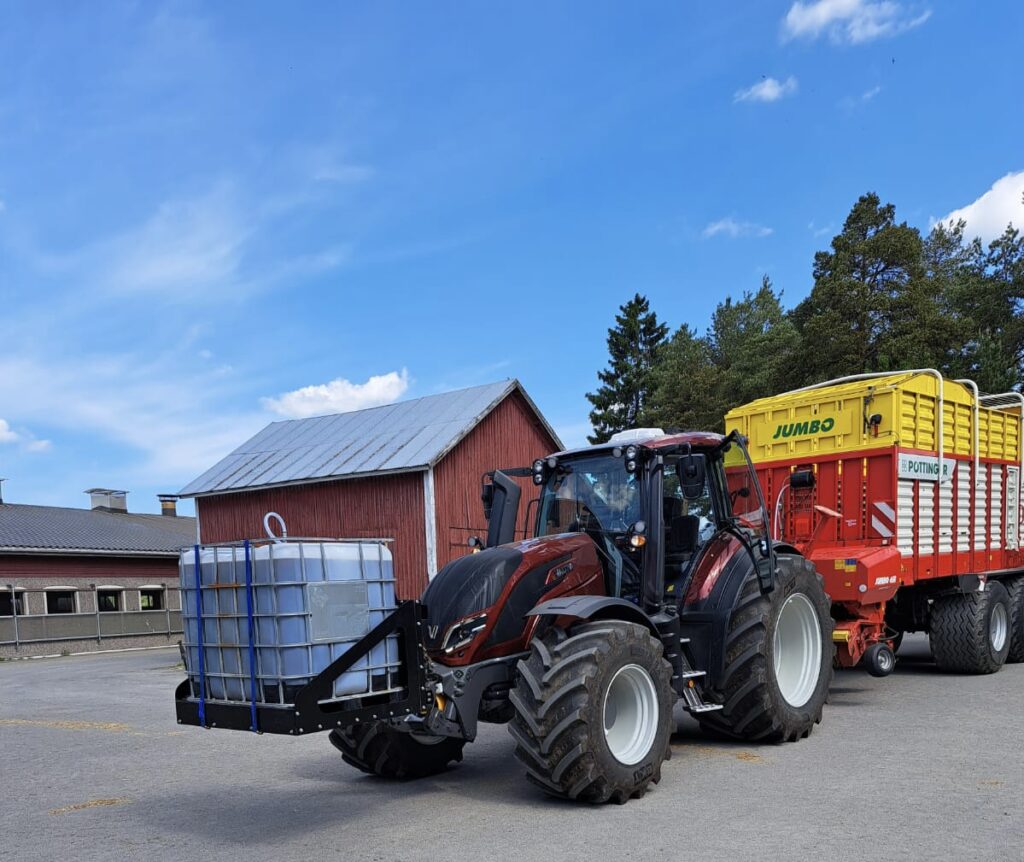
It is also worth bearing in mind a particular characteristic of a partially filled tank: the liquid is able to move about more freely than in a full tank. This can feel like “rocking” or a delay when you turn, brake or drive over ruts. That is why some professionals prefer either a significantly underloaded vehicle (lower mass) or a nearly full load (less movement) – but always depending on the situation, the machine and the terrain.
Rack load-bearing capacity and loading: static versus dynamic design
Load-bearing capacity of the rack It is not just a question of “how much weight the rack can bear on a flat surface”, but also how the load is transferred to the attachment points, the frame and any locking mechanisms. When you drive over a pothole, the load tends to “jerk” upwards or to the side for a moment. If the rack is dimensioned too tightly, fatigue loads and movement at the joints will begin to manifest over time: as loosening, fractures or deformation.
A good practical guideline is to design the rack so that it can withstand a load that is significantly greater than the total static mass. No single multiplier can be applied to all machines and all terrains, but the idea is that the “rated load” is not the same as the actual working load. In particular, in property maintenance (sweeping, washing, manoeuvring) and on farms (field tracks, uneven ground in the yard), the load is variable in nature.
When the mass of an IBC container is calculated correctly, the design of the rack is not a matter of guesswork but a controlled process of risk mitigation – particularly during transport and lifting.
What you should check when loading a rack These points will go a long way towards helping you get off to a good start even before your first day at work.
Route of the consignment Where exactly on the frame is the load actually transferred: the spikes, the three-point hitch, the adapter plate or the boom assembly?
Locks and safety devices Is the tank also mechanically prevented from moving sideways and during braking?
Operating environment Smooth tarmac versus a yard or farm track with frost damage changes the dynamic load dramatically.
Maintenance and inspection Regular visual checks of bolt torques and welds help to prevent unexpected failures.
If you wish to find out more specifically about the requirements and practical safety checks relating to scaffolding, the Lootu Oy website has a separate section on the subject: CE marking for IBC container racks, machinery and occupational safety. It helps to illustrate why simply saying “it’ll do” isn’t enough when loads are being lifted and transported on a daily basis.
Dimensioning of tractors and wheel loaders: lifting capacity, axle loads and centre of gravity
From the machine’s point of view, the total mass is only the first indicator. The next question is: where the centre of gravity is located and how this affects the axle loads. For example, an IBC load attached to the three-point hitch at the rear of a tractor often “lightens” the front axle. This impairs manoeuvrability and braking feel, and can make work unsafe, particularly on the road or on a slope. With a front loader, on the other hand, the load is often transferred to the front axle and towards the front, which can lighten the rear end and reduce the machine’s overall stability.
An important rule of thumb regarding lifting capacity is to read the manufacturer’s specifications correctly: lifting capacity is often stated at a specific distance (e.g. the distance from the pivot pin or the loader arm). When the load is “further away” or higher up, the actual capacity is reduced. Furthermore, dynamic situations (bumps, braking, side tilt) increase the load on the machine. Therefore, keeping the load as low as possible and close to the aircraft improves safety more than many people realise.

In property maintenance and contracting, the choice of machinery is often linked to the speed of work: a wheel loader is agile for moving materials and handling loads, whilst a tractor is powerful for towing and versatile when fitted with attachments. If you’re considering the right combination for your application, you might find the following a useful read: A tractor or a wheel loader for moving an IBC container?
A brief note
If you’re driving long distances in the Oulu region or moving between different job sites during the day, load management becomes particularly important: even a small amount of extra weight and the correct securing height have a direct impact on handling.
Take a look at the 7 most common transport errors and avoid them
Accessories and fittings: the pump, hoses and mounting brackets alter the load
Many people simply calculate “IBC + water”, but in practice it is the work equipment that determines how the load behaves. For example, a pump and hose reels can add a surprising amount of weight, but even more significantly, they can shift the centre of gravity to the side or forwards. If hoses and fittings are hanging outside the chassis, they can also be damaged, creating a risk of leaks and the need for additional repairs.
The effect of the equipment is also evident during lifting: if the rack has a tall structure or a protective arch, the load may rise higher than you anticipate. In such cases, the risk of tipping increases, particularly with a partially filled tank. A good aim is to set up a configuration where: (1) the tank is mechanically locked in place, (2) the hoses are protected and routed in a controlled manner, and (3) the load is close to the machine.
Sizing of equipment – practical benefits Small structural changes often yield greater safety benefits than simply using “stronger steel”.
Controlled routing of hoses Reduces slippage, leakage and swaying during transitions.
Shielded connectors Prevents knocks and speeds up connection during busy periods.
Centre of gravity close to the fuselage Improves handling and reduces peak loads on the front and rear axles.
Clear operating logic When valves and shut-off valves are within easy reach, the number of errors is reduced.
If the use involves, for example, brushing and washing, the availability and dispensing of water form part of the overall “water logistics”. In that case, you may also wish to read: Water for brushing and assess your own equipment in light of the desired workflow (filling, transfer, use, emptying).
Safe dimensioning in everyday life: use calculations, take measurements and keep records
Once the weight and load of an IBC container have been correctly calculated, the next step is to make this a repeatable routine. The recommended practice is to draw up a machine-specific “load card” containing at least: the maximum permitted volume (l) for that particular machine and rack, the estimated total mass (kg), the configuration of the equipment, and a reminder to keep the load low during transit. This also helps temporary and seasonal staff to operate in the same way.
It is also worth considering the specific application: on a farm, the focus is often on field tracks and turns, whereas in property maintenance it is on manoeuvring, braking and a fast work cycle. When working in areas such as Kempele, Oulu, Liminka or Tyrnävä, the quality of the surface varies: tarmac, gravel yards, frost-heaved sections and kerbs result in uneven loads. For this reason, the “reliability” of the frame and mountings is often a more important criterion than the static load-bearing capacity being just sufficient.
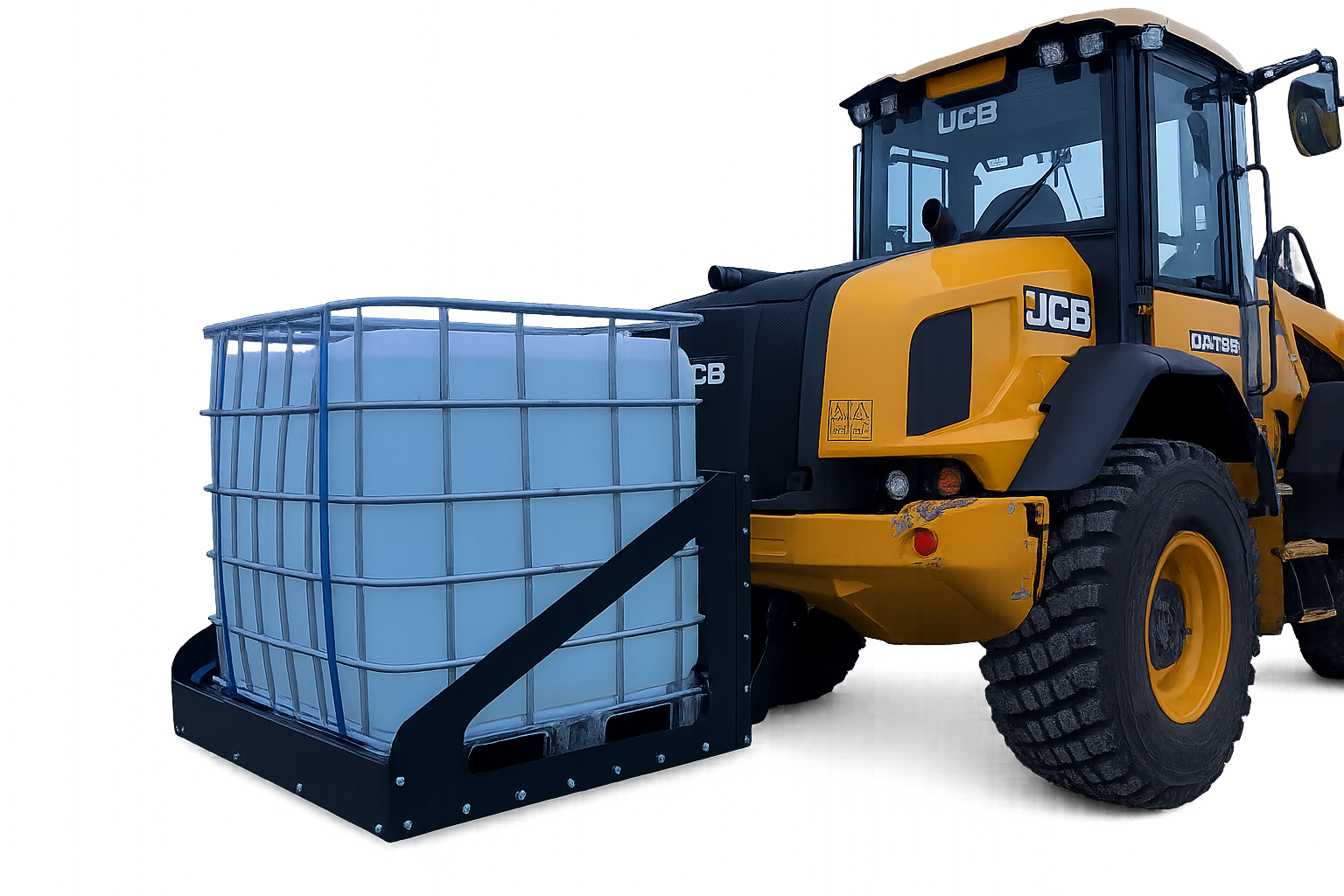
At the heart of Lootu Oy lies metal product expertise rooted specifically in the practical needs of the job: sturdy and easy-to-install racks for IBC containers on tractors and wheel loaders. If you want to ensure that the dimensions, mounting and day-to-day usability are all in line with your requirements, start with the basic calculations (tank + liquid + accessories), and then check the machine’s lifting capacity and centre of gravity. If necessary, it is worth consulting an expert and specifying the intended use: whether you’ll be transporting irrigation water, washing water, preservatives or liquid fertilisers – and along which routes.
You can find more background on the everyday use of IBCs in the articles by Lootu Oy: Articles. If, on the other hand, you’d like to see how the same tank frame works in a variety of farm applications, take a look at: An IBC container on a farm: a versatile solution.
Summary: When you calculate the total weight of the IBC container assembly (liquid + container + rack + accessories), you obtain a figure that can be used as a basis for decision-making and compared with the machine’s lifting capacity and operating conditions. When you also take into account the centre of gravity and dynamic load, the design becomes safe and predictable – and the work runs smoothly both on the farm and in property maintenance.
Would you like to check the dimensions before making a purchase?
Please tell us the intended use (farm or property maintenance), the machine and the volume required – we’ll help you safely assess the load and select the appropriate rack configuration.
Frequently Asked Questions
How much does 1,000 litres of water weigh in an IBC container?
Why does a partially filled IBC load feel “more unstable” when driving?
How should the load-bearing capacity of a scaffold be interpreted in practical work?
Is a tractor’s lifting mechanism sufficient if its rated lifting capacity on paper is over one tonne?
What additional equipment should be taken into account when calculating the total mass of an IBC container?
Interested? Get in touch with us!
Please get in touch with us using the form below